

Come learn more about COGE on Thursday, June 18, at 6:30pm in downtown Manhattan!
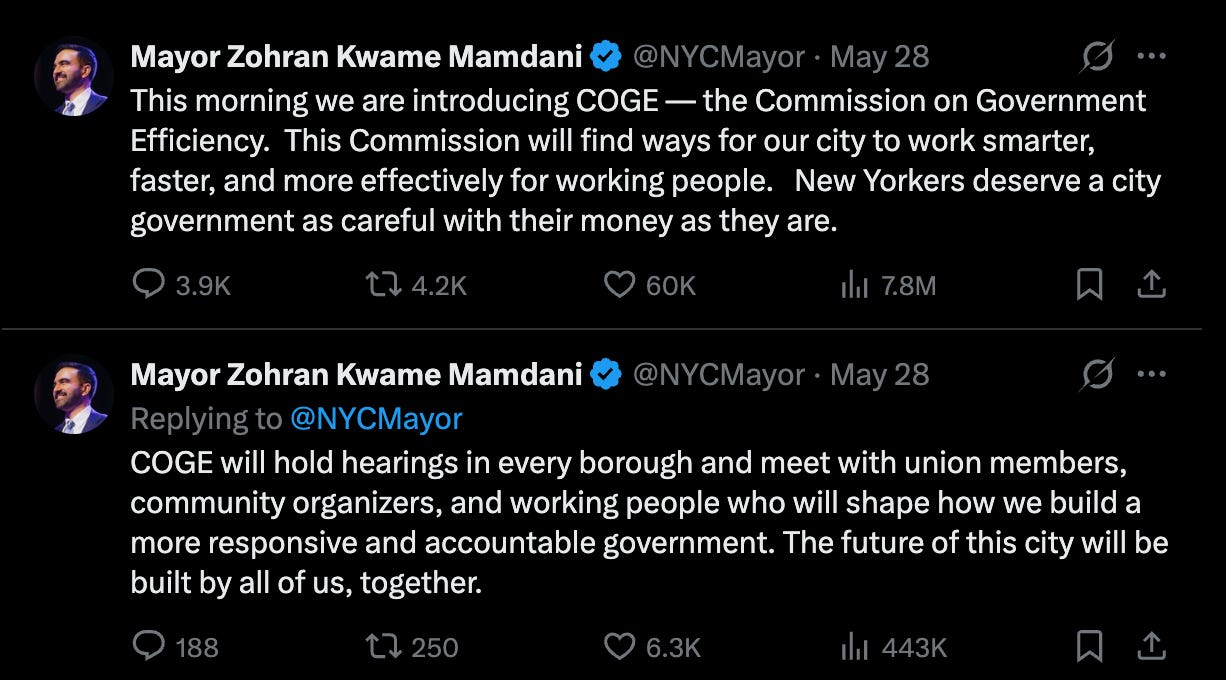
This past Thursday, May 28, Mayor Mamdani announced the creation of COGE, the “Commission on Government Efficiency.”
COGE is a charter revision commission (“CRC”), a special type of temporary entity created pursuant to New York State law.1 A CRC reviews the city charter and proposes changes to it. Those changes can be small and narrow, or complete overhauls. Those changes are then placed on the ballot for the citizens of New York City to approve or disapprove, and this must be done no later than the second general election after the CRC is created. Once that vote is taken, or the second general election passes without a vote, the CRC is automatically dissolved.
Mayors are empowered to unilaterally appoint a CRC per state law, which is what Mayor Mamdani did. You can read about his 15 appointees, and 1 suggested Executive Director, in the COGE mayoral press release.
FYI: The City Charter
If this is your first time thinking about CRCs, you might have questions. CRCs are definitely not an “introductory level” idea in the realm of city and state government. Here are some good things to look into that can help provide conceptual clarity about them:
What is the New York City charter? This is the book of law that CRCs are empowered to propose changes to. Besides the charter, NYC has two other principal books of city law: the Administrative Code and the Rules of the City of New York. We also have a zoning resolution.
The charter is like the city’s constitution, in that it lays out the fundamental frame and procedure of city government; legally, it is not a constitution like the state or federal constitution. CRCs may not propose changes to any book of law besides the charter, although charter changes affect the other books.
Further: CRCs may only propose changes to the charter that are within the authority of the city government to make. Many things about NYC’s government and law are required by superseding state law, including provisions in the charter. The charter must comply with that higher state law.
But CRCs still have immense power to reshape how NYC works. In 1989, a mayoral charter revision commission completely reshaped the city government in response to a U.S. Supreme Court ruling.
💡 If you want to know more about all the ways to change the New York City charter, including a deeper dive into the law that enables those mechanisms of change, I wrote a post about that here.
💡 If you want to know more about New York City’s principal books of law, you should read the New York City Council’s Bill Drafting Manual, sections 1.3.2 and 1.3.3.2
How to engage with this CRC and place an informed vote this November
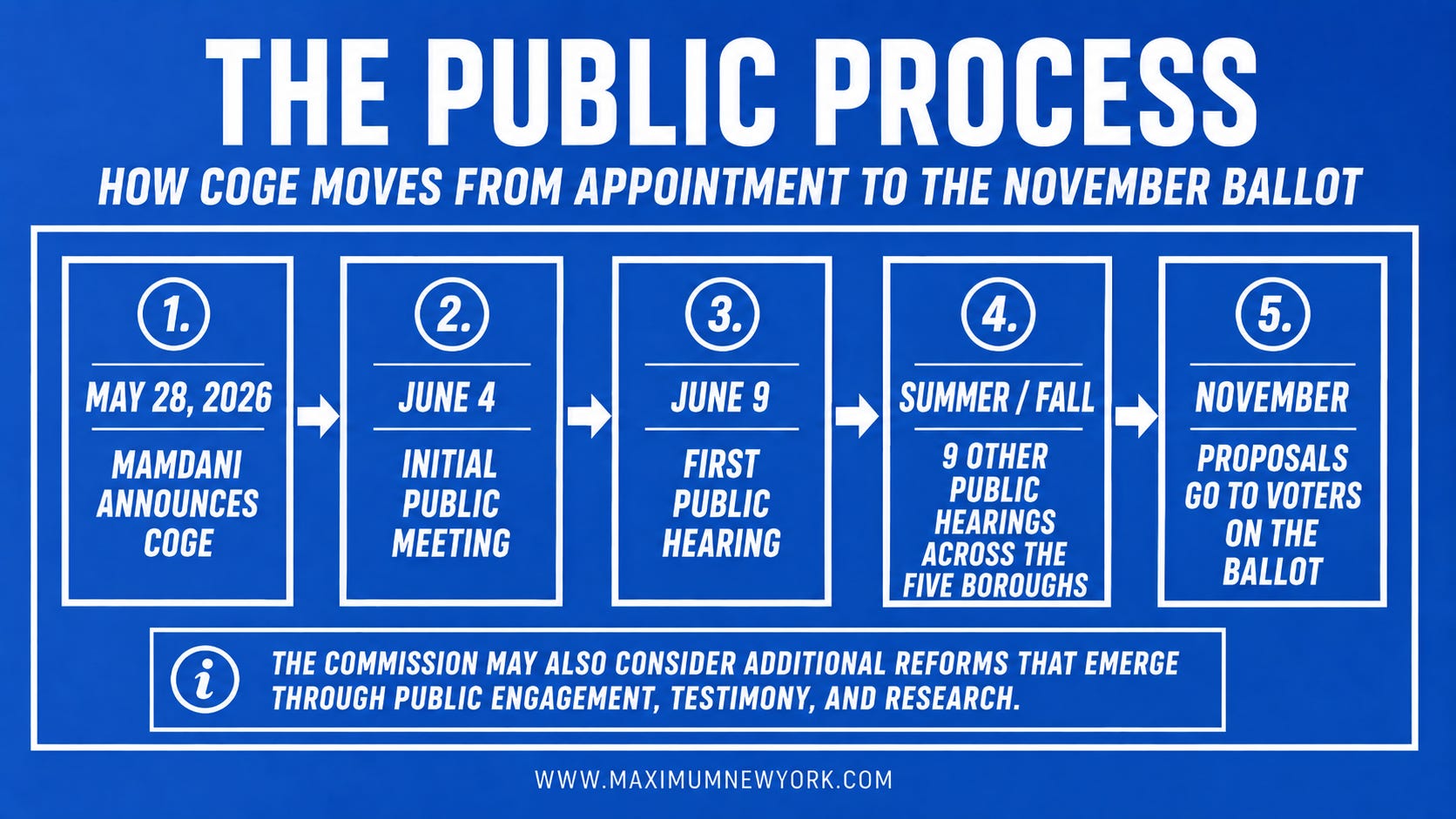
Summary: attend the meetings, read the reports the CRC staff puts out, and grab some friends to do both with. If you want an example of what I, Daniel, consider to be a very well-run CRC, look at the schedule and outputs of Mayor Adams’ 2025 CRC3, which was established in December 2024 (press release here); see their cadence of meetings and reports. We voted on that CRC’s proposals this past November, 2025.
If you’re one of those people who tries to figure out how to vote on ballot propositions like a week before the election, this section is for you.
The mayor’s COGE press release says that the CRC’s proposed charter amendments will be on our ballots this November, 2026. Prior to that point, you will have many opportunities to engage with the CRC’s process as they develop their ballot questions. How?
You can attend their meetings. The CRC’s first organizing meeting will be June 4 at 5pm (this Thursday). After that, there will be 10 public hearings around the city where members of the public and invited experts will deliver testimony to the CRC about charter changes they think should be made. The first of these 10 is already scheduled for June 9 at 5pm, although the location hasn’t been announced. You will need to follow this page (or me on X, or this Substack) for further updates about time and place for all of the meetings.
I have given testimony to several past CRCs. You can find my suggestion to rename the office of the Comptroller here, and suggestions for growth here.
I highly encourage anyone who is interested to both attend the CRC’s meetings, and to deliver testimony. Putting aside the likelihood that your suggestions will actually make it onto the ballot, it is an extremely worthwhile skill to prepare and deliver testimony to a governmental body on the public record. This is self-government incarnate.
💡 An offer of help: If you don’t feel equipped to prepare testimony, or you’d like further help just thinking through what the city charter is and how it can be changed, I’m happy to help. This is an open offer to any group: I am happy to co-host or show up to an event aimed at teaching people about the charter, CRCs, and how to interact with this one in the form of meeting attendance, report scrutiny, testimony provision, and more. Just let me know. I have several broad goals: help people cultivate the civic muscle of considering their law and how to change it, how to speak to their government on the record, and how to evaluate the outputs and process of the CRC—their staff reports, meetings, and ultimately their ballot questions.
Some confusion on the name “COGE.” Is this a city DOGE?
This CRC—Commission on Government Efficiency—is named in response to DOGE, the federal “Department of Government Efficiency,” which was established pursuant to President Trump’s Executive Order 14158 on January 20, 2025. (More on executive orders, particularly mayoral, here.)
Mayor Mamdani’s initial X post announcing COGE also echoes the stated ideas that motivated DOGE: “This Commission will find ways for our city to work smarter, faster, and more effectively for working people. New Yorkers deserve a city government as careful with their money as they are.” From discussion on an X Space from August 2024 (accessed May 31, 1:50:00-1:50:19) about the future DOGE:
Elon Musk: I think it would be great to just have a government efficiency commission that takes a look at these things and just ensures that the taxpayer money, the taxpayers hard-earned money is spent in a good way. I’d be happy to help out on such a commission…
(then-presidential-candidate Trump): I’d love it.
There’s some commentary to be had about the call-and-response naming, but I’m not here to do that. I’m here to clear up some confusion that it has caused!
COGE and DOGE are legally distinct things; they are not just city and federal versions of the same kind of thing, even if they notionally aim at governmental streamlining. It is important to understand this.
COGE is a New York City charter revision commission created pursuant to New York State law. It is a regularly used and tightly prescribed tool. Although Mayor Mamdani can appoint all the members of the commission, and although the mayor can exert a lot of influence over it, it is legally (but perhaps not practically) independent4 and sits outside the mayor’s office. Finally, a CRC performs a legislative function: it suggests changes to the city charter.
DOGE is two things: per §3(a) of EO 14158 (emphasis added):
Reorganization and Renaming of the United States Digital Service. The United States Digital Service is hereby publicly renamed as the United States DOGE Service (USDS) and shall be established in the Executive Office of the President.
And per §3(b) of EO 14158 (emphasis added):
Establishment of a Temporary Organization. There shall be a USDS Administrator established in the Executive Office of the President who shall report to the White House Chief of Staff. There is further established within USDS, in accordance with section 3161 of title 5, United States Code, a temporary organization known as ‘‘the U.S. DOGE Service Temporary Organization’’. The U.S. DOGE Service Temporary Organization shall be headed by the USDS Administrator and shall be dedicated to advancing the President’s 18-month DOGE agenda. The U.S. DOGE Service Temporary Organization shall terminate on July 4, 2026.
So: DOGE is the renamed U.S. Digital Service (USDS), which performs governmental modernization work, and it is also the name of a temporary organization within USDS that expires this July 4, 2026. Temporary organizations, per federal statute, may not exist for longer than three years, and they have more operational flexibility than non-temporary parts of the government to achieve their objectives. DOGE the temporary organization will cease to exist on July 4, 2026, but DOGE the renamed U.S. Digital Service will remain. Both DOGEs exist within the executive office of the president, and are not independent from the executive in the way that a mayoral CRC is. They also do not perform legislative functions like a CRC does, and are fundamentally aimed at administrative changes.
Most of what you might have heard about DOGE in the news is likely about the §3(b) temporary organization DOGE and its related activities.
When passing a local law, the City Council can amend either our Administrative Code or our City Charter (with certain limitations found in §38). As a result, these books can begin to resemble each other in an unhelpful way. The Council’s Bill Drafting Manual lays out the challenge in section 1.3.2:
When deciding whether to place a provision in the Charter or the Administrative Code, a drafter should keep in mind that if the Charter is amended frequently to add routine or lengthy administrative schemes and thus begins to resemble the Administrative Code, then its usefulness to government practitioners and the public could be compromised. It is generally understood that the Charter may contain broad references to a power or program, while the details of programmatic implementation, including reporting obligations, usually belong in the Administrative Code. Frequently, a local law can address in a detailed fashion through an Administrative Code amendment a subject matter that already is within an agency’s broad Charter purview. This distinction does not make the Administrative Code a less important document; both the Charter and the Administrative Code have the force of law.
In practice, the distinction between the Charter and the Administrative Code can be murky at times but remains important. Even when it seems straightforward that provision A belongs in the Charter and provision B belongs in the Administrative Code, previous amendments may have put similar provisions in one when the other would seem to make more sense. It can be useful to follow the lead of similar provisions, but a drafter should keep in mind the separate purposes of the Charter and Administrative Code and use judgment in determining which body of law to amend. It is helpful to think about where one might expect to find the provision when doing legal research and aim to keep the Charter from becoming more cumbersome and both the Charter and the Administrative Code from becoming more confusing.
While CRCs are legally independent once they are established, in practice they are organizationally and politically connected to whoever appointed them. Mayoral administrations often give their CRCs announced mandates to pursue, and they often allocate funding and staff to their CRCs.
How optimistic are you about COGE making NYC government more efficient and/or saving money?
Given the independence of CRCs after they’re established, I’ve been wondering: could a mayor begin one hoping they propose a certain charter reform but then the appointees propose completely unrelated reforms, or perhaps even opposite changes to what the mayor desired? Have we seen any such cases in previous CRCs?