

I was at a Christmas party last week, and everyone was having a wonderful time. There were friends new and old, and the spirit of the season was truly among us.
And then someone made a light hearted, descriptive reference to a contemporary political figure—not a normative statement, nor a joke. Just a necessary bit of detail for an otherwise non-political comment. The person next to me, upon merely hearing the name, then leaned over to my side of the table and, face twisted with contempt, spat utter poison into the conversation. Both profanity and poor wishes were among the laced words.
The event was not endangered by this, mostly because everyone in attendance did not have a reactionary personality, nor did they take one person’s brief, impolite, misplaced soliloquy as an invitation to debate or conversation—we did not ingest the poison. We simply moved right along, warmly embraced by Christmas charity and togetherness. And the individual with the reactionary moment themselves came right with us, resuming their normally delightful presence. Nothing more was made of the vulture’s shadow that passed over us.
This isn’t the first time I’ve experienced this kind of interaction—an otherwise amiable person is suddenly seized, as if possessed, by cruelty and disregard. They are seemingly not in control of themselves, and make uncharacteristic statements wishing specific deaths upon others, sexual assault in men’s prisons, and other baldly uncivilized comments. Their facial features twist with pleased bitterness, and their presence triggers the same part of the brain that would activate upon sight of a rabid dog. One knows that they are no longer a trusted interlocutor who can handle things with grace; they must be treated carefully, either to guide them back to self control and sanity, or to excise them from the conversation (and the event, if need be).
What is it that happens to people in these situations? What is the demon that possesses them?
It is contempt.
More specifically, it was political contempt. And for New York and America to secure the future, we must defeat this vice within ourselves and our citizenry. The first step is understanding what we’re dealing with.
Contempt: the terrible spoonful of sugar
Contempt’s essential facet is a psychological distancing between the object of contempt and the contemner. The contemner regards the person or object of contempt as fundamentally outside their moral frame, fundamentally different, and perhaps even subhuman in the most extreme instance. Contempt is an emotional response to encountering a breach, violation, or negation of a value. The strength of contempt is measured by the damage to one’s values, or the expected threat to them. It can be fleeting, or it can be pathological.
And since contempt is an emotional response to one’s values, there can be justified and unjustified contempt. Like justified anger, justified contempt is appropriate, even healthy when expressed well. Justified contempt is felt by an individual who has truthfully appraised the target of their contempt, truthfully appraised their values, and who manages the emotion in a fashion commensurate with that which is contemptible. This individual would also understand that contempt, like anger, burns the spirit and curdles the mind if it’s held more than temporarily. To them, contempt is necessary, but must be used carefully and discarded as soon as possible.
Contempt becomes a problem when it is not justified: when it is stoked carelessly, used expansively, and when its target is never really investigated for any breach of value. Unjustified contempt, which could also be called unearned contempt, but going forward will just be “contempt,” assassinates the character of the contemner. It points at someone and says, “They are not worthy of tolerance, respect, acceptance, or persuasion. They are not even really human like you. Do what you will!” It opens a distance, or a void, and through that void come every barbaric impulse. It is permission.
But why would someone succumb to contempt like this? Why degrade their character and embrace the malice and gleeful bitterness that contempt permits? What made my nice Christmas interlocutor suddenly pursue the destruction of a nice evening of good will? What made them blind to how they would be perceived by others upon such an outburst?
Because contempt is sweet, and it overwhelms internal resistance to unleashing viciousness. It is the spoonful of sugar to make the vice go down. And who has not felt the pleasure of anger? The pleasure of self-righteousness, and the perverse delight in condemning others? The appeal is very clear, and one can see why a sweet little contemptuous treat easily bears them into the soul.
But contempt is sweet like lead. If regularly indulged, it will make you weak, dumb, and ill.
Political contempt: bane of democracy, cancer of the demos
I’m sure everyone reading this essay knows someone, probably several people, who have an atavistically cartoonish view of whomever they view as “the bad guys” in politics. They cannot be talked out of their sensationalized view of these villains, and even truth in the form of easily verifiable, understandable information is no help. And there is no middle ground with them, only “friend” or “enemy.”
Per Andy Masley:
Under discussed bad thing that happens to people is getting really attached to having very specific bad guys in their pantheon, because it adds narrative structure to their lives. I've seen people's thinking get completely clouded by what looks from the outside like little acts of worship of specific bad guys' roles as bad guys. Every discussion just circles back to psychic warfare on the astral plane against the bad guy rather than what's actually helping the world.
At the base of this worldview is often political contempt. The politically contemptuous have cast certain people and groups as “the bad guys,” placed vast psychological distance between themselves and those people, and in so doing completely excuse themselves from having to understand, persuade, live with, or tolerate them. The only thing left to do is treat them as the demons that contempt says they are, and punish anyone who says otherwise.
This kind of political contempt is non-concrete. It’s easy. It’s political hobbyism’s most common endpoint. It doesn’t require one to actually know anything, just to imbibe algorithmic feeds of short-form video—just put on your team’s jersey and wish death upon the other team! And if anyone comes along and does ask for reasonable substantiation for the contempt, one can always fall back on non-concrete assertion to avoid facing the truth of what political contempt has done to one’s mind and character.
Needless to say, political contempt is acid to a free and prosperous society, and a complete abrogation of de Tocqueville’s society of joiners. A contemptuous political society does not seek to persuade, but to dominate. In many ways, political contempt is the full realization of the dangers of faction, as James Madison famously warned of in Federalist No. 10:
By a faction, I understand a number of citizens, whether amounting to a majority or a minority of the whole, who are united and actuated by some common impulse of passion, or of interest, adverse to the rights of other citizens, or to the permanent and aggregate interests of the community.
In his own time, Abraham Lincoln also recognized that the greatest danger to the United States would not come from the outside, but from ourselves. From his 1838 Lyceum Address:
How then shall we perform [the perpetuation of our political institutions]?—At what point shall we expect the approach of danger? By what means shall we fortify against it?—Shall we expect some transatlantic military giant, to step the Ocean, and crush us at a blow? Never!—All the armies of Europe, Asia and Africa combined, with all the treasure of the earth (our own excepted) in their military chest; with a Buonaparte for a commander, could not by force, take a drink from the Ohio, or make a track on the Blue Ridge, in a trial of a thousand years.
At what point then is the approach of danger to be expected? I answer, if it ever reach us, it must spring up amongst us. It cannot come from abroad. If destruction be our lot, we must ourselves be its author and finisher. As a nation of freemen, we must live through all time, or die by suicide.1
The leaders of New York City and State also knew that if New York were to fail to live up to its greatness, it would be its own fault. From an 1897 volume of Municipal Affairs discussing New York City’s future, on the eve of the consolidation of the five boroughs (emphasis added):
It is only now that our city has so grown as to begin to realize her natural advantages, only now that the widely extended features of our site begin to coalesce into such a grand and beautiful whole as, until the very plan of the continents is changed, can be realized by no other city on earth. “With its noble harbor protected from injury, and the channels of approach straightened and deepened; with its wharves and docks made adequate for the easy transfer of the vast commerce of the country; with its streets properly paved and cleaned, and protected from destructive upheavals; with cheap, easy and rapid transit throughout its length and breadth; with salubrious and attractive parks in the centres of dense population; with an ample supply of pure water, now nearly provided; with a system of taxation so modified that the capital of the world may be as free to come and go as the air of heaven, the imagination can place no bonds to the future growth of this city in business, wealth and the blessings of civilization. Its imperial destiny as the greatest city in the world is assured by natural causes, which cannot be thwarted except by the folly and neglect of its inhabitants.”2
Political contempt pulls citizens apart, and sets them into enemy camps. It causes New York and the United States to fall to the only enemy that can really threaten it—its own citizenry in disarray. What’s worse, there are people who can profit off of this. The more you watch their shows, listen to their podcasts, buy their merch, seek their validation, and click on their ads, the better off they are. The more you unthinkingly repeat condemnations of “the bad guys,” the more you refuse to look at them for what they fully are, the more you refuse any information that threatens your clean friend/enemy distinction, the more your own ability to live as a free citizen degrades.
Political contempt is dangerous because it is sweet, and because when most people recognize it in themselves, they don’t call it that. They call it righteous fury. And it is so easy to defend limitless righteous fury to oneself:
“But Daniel—the other side wants to destroy everything we love! We can’t tolerate that, you have to draw a line somewhere.”
Of course you have to draw a line somewhere—the paradox of tolerance is that, at some point, you would tolerate your own destruction. But here’s the thing: I often get this argument from people who have never once tried to understand their “other side” as much as they wish their “other side” would try to understand them.
In most circumstances, this is an indication that the person has not really tried, and they want to immediately jump to dismissing people as “other” or “irredeemable.” This kind of person uses the existence of a limit on tolerance as an excuse to abandon it, and the treasures that lay beyond it, altogether.
But if political contempt is so tempting, how can anyone overcome it? Not just the most extreme version of the foaming ideologue, but the everyday refusal to meet or talk with anyone who is different in noticeable ways?
The answer lies in contempt’s essential characteristic: dehumanizing distance. To overcome distance, we must come closer to others. Close enough to see them for what they actually are, and what they actually could be. Close enough to see some improbable connection that, against odds, knits us together. Close enough to live up to the great, binding motto of our nation: E Pluribus Unum.
How to do that can only really be explained by example. So I have three for you.
1) Ayn Rand taught me political and personal tolerance by stoking my love for a young communist named Andrei Taganov.
This particular example is the most funny to me, because it surprises some people in about five different ways at the same time.
While many might know her for the novels The Fountainhead (1943) or Atlas Shrugged (1957), my favorite Rand novel is her first and least known, We the Living (1936). It takes place in post-revolution Soviet Russia, and follows the protagonist Kira Argounova as she tries to make her way in the new world that’s forced itself upon her. She is an individualist, and falls in love with another young man who opposes the Soviets, Leo. But she soon meets and befriends Andrei Taganov, an earnest communist and hero of the Revolution.
Andrei was written as “the best possible communist.” He is honest, sincere, and a moral idealist. He demonstrates physical courage in the face of danger, and lives an austere life dedicated to supporting the new regime that he truly believes will usher in an era of human flourishing. Naturally, he abhors the corruption he increasingly witnesses in the new Soviet regime, regarding many fellow “communists” as vicious opportunists.
Rand in no way wants readers to agree with his ideals, which she regards as a tragic error of knowledge, and a demonstration that bad ideas always come home to roost, but she did purposefully write Andrei as an admirable man. See this exchange between Kira and Andrei:
“Then you do see what these times of yours are?” [asked Kira].
“We all do. We’re not blind. I know that, perhaps, it is a living hell. Still, if I had a choice, I’d want to be born when I was born, and live the days I’m living, because now we don’t sit and dream, we don’t moan, we don’t wish—we do, we act, we build!”
Kira liked the sound of the steps next to hers, steady, unhurried; and the sound of the voice that matched the steps. He had been in the Red Army; she frowned at his battles, but smiled with admiration at the scar on his forehead. He smiled ironically at the story of Argounov’s lost factories, but frowned, worried, at Kira’s old shoes. His words struggled with hers, but his eyes searched her for support. She said “no” to the words he spoke, and “yes” to the voice that spoke them.
Or Kira’s inner conflict over her unmistakable approval of Andrei:
Kira seldom spoke of what she thought; and more seldom—of what she felt. There was a man, however, for whom she made an exception, both exceptions. She made other exceptions for him as well, and wondered dimly why she made them. Communists awakened fear in her, a fear of her own degradation if she associated, talked, or even looked at them; a fear not of their guns, their jails, their secret, watchful eyes—but of something behind their furrowed foreheads, something they had—or, perhaps, it was something they didn’t have, which made her feel as if she were alone in the presence of a beast, its jaws gaping; whom she could never force to understand. But she smiled confidently up at Andrei Taganov.
Or, finally, the scene that solidified my energetic rejection of provincial guilt by association, which also finally gave me an emotional understanding of the story of Jesus sitting down to dinner with sinners:
“Are you going home, Comrade Argounova?” [Andrei] asked.
“Yes, Comrade Taganov.”
“Would you mind if you’re compromised by being seen with a very red Communist?”
“Not at all—if your reputation won’t be tarnished by being seen with a very white lady.”
I first read We the Living at the end of high school, and I remember, as much as I ever had with a fictional character, falling in love with Andrei. I admired his sheer force of will, his commitment, his unimpeachable character—and his sweetness. This would eventually turn into a tragic love, given how his character ultimately ends, but it left an indelible mark on my heart. Like Kira, I wondered at the unmistakeable fact that I felt so strongly, and so favorably, for a revolutionary communist. I abhor that ideology, and yet: here, in my heart and mind, stands Andrei to this day. Whether other people have angels or devils on their shoulder, I do not know. But I at least have Andrei.
The emotional experience of both loving Andrei for his virtues, and also finding a limit based on the values to which he had committed those virtues, created the reference point I use to this day when I encounter someone dramatically different from me, especially in politics. I am reminded to see them for everything that they are, and to interact with the whole. This does not require me to compromise anything I believe, and in fact requires a sharper view when perceiving the souls of others. And unlike Andrei, the people I meet here in reality, and our relationships, are not condemned to a tragic end.
2) Shirley Chisholm and George Wallace: When the first black woman in Congress went to visit the avatar of Jim Crow in the hospital.
When Shirley Chisholm (a New Yorker) was elected to the U.S. House of Representatives in 1968, she became the first black woman in our national legislature. Her life story is remarkable, and it’s impossible to do it justice in a post like this. But I most fundamentally admire her dedication to America, and to doing the hard, messy work necessary to keep it all together.
After only serving in Congress for a few years, she decided to run for president in 1972. She opened her candidacy on January 25 of that year in Brooklyn with a speech that began like this:
I stand before you today as a candidate for the Democratic nomination for the presidency of the United States of America.
I am not the candidate of black America, although I am black and proud.
I am not the candidate of the women’s movement of this country, although I am a woman and I’m equally proud of that.
I am not the candidate of any political bosses or fat cats or special interests.
I stand here now without endorsements from many big-name politicians or celebrities or any other kind of prop. I do not intend to offer to you the tired and glib clichés, which for too long have been [an] accepted part of our political life.
I am the candidate of the people of America. And my presence before you, now, symbolizes a new era in American political history. I have always earnestly believed in the great potential of America. Our constitutional democracy will soon celebrate its 200th anniversary, effective testimony to the longevity of our cherished Constitution, and its unique Bill of Rights, which continues to give to the world its inspirational message of freedom and liberty.
Beautiful words, but even they underplay Chisholm’s dedication to working within the system to change the system, and preserving America as both an ideal and something to be improved. To get a true sense of that, one needs to examine a pivotal event in the 1972 presidential campaign itself: when George Wallace, a fellow contender against Chisholm for the Democratic nomination, was shot.
Wallace, for those who might not know, delivered these infamous words during his 1963 inaugural address as governor of Alabama (emphasis added):
In the name of the greatest people that have ever trod this earth, I draw the line in the dust and toss the gauntlet before the feet of tyranny...and I say...segregation now...segregation tomorrow...segregation forever.
When he was campaigning for president in a suburb of Washington, D.C. in 1972, one member of the crowd met him with a pistol, multiple shots at point-blank range, and injuries that would leave him paralyzed from the waist down for the rest of his life.
And while he was at the hospital, Shirley Chisholm paid him a visit to wish for his recovery.
Before rushing to a verdict on her action, take a moment to imagine the dynamics of that situation.
Wallace was segregation incarnate. Chisholm was the first black woman in Congress, and running against Wallace in the presidential Democratic primary. Chisholm needed all the help she could get in her race, and this one visit alienated and angered many people. She knew it would, and she did it anyway. Why? I’ll let her speak in her own words. Here’s an extended excerpt from chapter eight of her 1973 political memoir, The Good Fight, recounting the 1972 presidential campaign (emphasis added):
It was impossible for me not to think of the risk of being attacked, a danger that had occurred to me many times before. Most public figures attract a certain amount of hate mail; I had always received my share, most of it depressingly unimaginative in its obscenity and racial hatred…That unforgettable year of 1968 in which Martin Luther King’s killing was followed by that of Robert F. Kennedy was still fresh in everyone’s memory. Was 1972 to be another, and if so, who would be the next victim?
[…]
Most of the time the possibility is only a faint, nagging thought below the level of conscious attention. But from time to time it surfaces. I could not help musing that the taking of a life was perhaps only an extreme manifestation of the kind of political incivility that had become our national style in recent years. Deep personal hatreds and vendettas have been flaunted at the highest levels…The decline of civility and the mounting crudeness of language in our public life could also be another reason for the disgust of people with politicians and government officials and the contempt manifested toward them. The consequences for public debate and the rational, civilized conduct of public affairs are grave. This collapse in communication is terribly sad. It is a steady tearing asunder of the few threads which bind us together in a society undergoing massive change. It is sad, too, that so many of our public personalities lack size, that tolerance and generosity that spring from self-confidence and goodwill.
When Governor Wallace was reported recovering and able to receive visitors at Holy Cross Hospital in Silver Spring, Maryland, I went to pay him a call. No two candidates, perhaps no two people, could differ more vehemently on many of the issues of public policy, but I could not see that this ought to have any relationship to our private behavior toward each other. With one of my Congressional staff aides and several Secret Service men, I drove out and spent twenty minutes with him. Governor Wallace seemed sincerely touched. He cried for a moment, and so did I. “Is that really you, Shirley?” he asked. “Have you come to see me?” What we talked about was nothing earthshaking; it was like almost any other sick call. I did say at one point, “You and I don’t agree, but you’ve been shot, and I might be shot, and we are both the children of American democracy, so I wanted to come and see you.”
The press was waiting outside when I emerged…Why should my visit be considered so colorful and newsworthy? Had politics, or race relations, reached such a point that it was to be thought of as bizarre? Naturally, some people began at once to speculate on my political motives for the visit. Why were they compelled to look for any? Was it so strange that my motive was only common decency and courtesy? There were black politicians who insinuated that some kind of a deal was being cooked up! One black man from Texas, a delegate pledged to me, was so angry that he threatened to withdraw his support. What hurdles we Americans must still have to clear as we grope our way toward a civilized society, when such a simple gesture is deemed newsworthy and a sign of political intrigue!
During the campaign there was a poster on sale in novelty stores that showed Governor Wallace and me in the famous pose of the painting American Gothic. I never quite got the point, if it had one, and I hope it was withdrawn from the market after the Governor’s tragic injury. But it was true that there was a parallel between George Wallace’s candidacy and mine, and there were places—such as northern Florida and North Carolina—where we seemed to be the only two candidates in the field. Although we represented opposite poles on many questions of policy, we both spoke for groups who felt dispossessed by the establishment and alienated by the course our society is taking. As I noted earlier, Wallace said of me approvingly, more than once, “She’s the only other one who says the same things in Florida that she says in Washington,” meaning thereby to indict his other primary opponents for what we might delicately term inconsistency.
[…]
This tolerance and mutual respect is fundamental to democracy’s survival.
Chisholm wasn’t a saint, and she has that in common with everyone else. But she was one of America’s greatest political dams against the rising tides of political contempt.
I’ll conclude this story with the line that stays most closely with me: “You and I don’t agree, but you’ve been shot, and I might be shot, and we are both the children of American democracy, so I wanted to come and see you.”
3) Friends who set an example, and populate their personal pantheons as others would not
Matt Bateman has an excellent thread on Twitter/X where he describes his intellectual relationship with James Baldwin that begins like this:

Matt goes on to pay Baldwin a beautiful tribute by showing us, through excerpts of Baldwin’s work, exactly why Baldwin belongs in his personal pantheon. I highly recommend reading through it. I hope you all have friends like this who openly share their expansive approach to human society and what it has wrought.
Far too few adults speak earnestly about their capacity to love others in this way. What is it that allows love to grow? What makes it endure? What gives it warrant? Can it be increased? What is its role in a world of difference?
Matt’s thread is a contemporary example (unlike my fictional and historical examples above) of the humanism to which I subscribe, relevantly described by Matt like this:
The love of human beings. The love of human nature, human potential, human greatness. An appreciation of human society, a positive sentiment towards one’s friends, and an intense love for one’s closest friends and family and also oneself. Humanism is an acknowledgment of human exceptionalism, of the wonder and power of human agency.
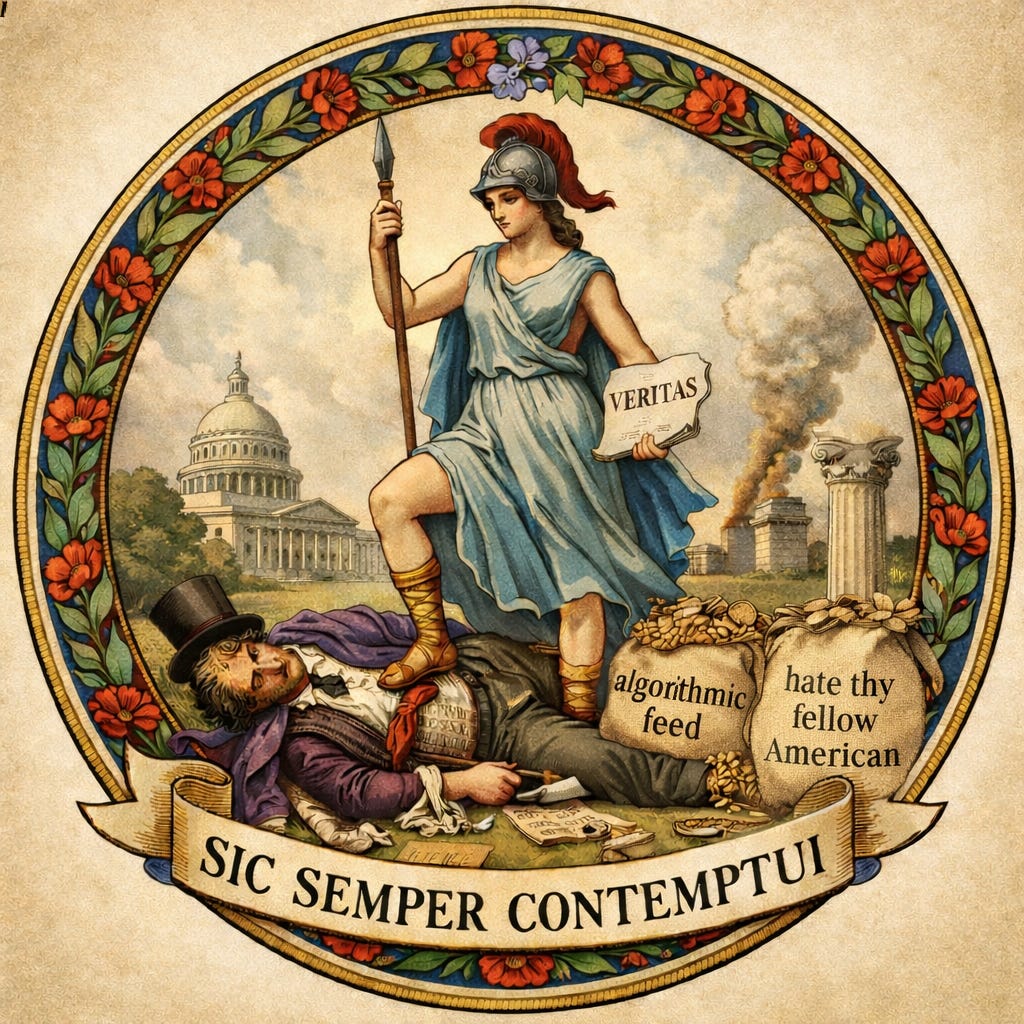
Sic semper contemptui
Political contempt has structural solutions—we can change our information systems. But one cannot wait for that day, and that lone is not sufficient. There is every bit of work to do ourselves in the meantime, and we can all influence what we put into the world.
Thankfully, just as humans possess an innate ability to devolve into contemptuous tribalism, we possess a seemingly unreasonable capacity to find connection among possible enemies, and progress among poisons.
We can gain help, comfort, and inspiration even from those who might otherwise work against us in some fundamental fashions. It should not work that way, and yet it does. And we live in a nation that allows this more than at any other time in history.
It is maddeningly, defiantly human.
It is the same bold defiance that cured my cancer. Failing pleasant oncologic medicine, humanity reached in bold, desperate genius to poisons for help. One could say this is a twisted irony of the universe, and that chemotherapy is a curse. And yet it works. And yet poison has been fashioned against its will into cure. Humanity reached into the toxic maw of death and—crying, screaming, vomiting, bleeding—pulled out dear, precious life.
Why connect with others who are different? Why preserve those connections? Why keep unyielding truth, not social approval, as the standard when evaluating the character of any of your fellow citizens? Why keep them in a pantheon? While it is not the same thing, one might as well ask why use poison to heal? Why fertilize our food with waste? Why grow strong by repeatedly enfeebling oneself in effort?
Because it can be done. Because cultivating a character that resists unwarranted contempt makes one better. Because it increases good in the world. Because it is our nature to bellow defiance at a universe that might not offer us any good options—and then set our hand to the impossible alchemy of turning lead into gold nonetheless. This is one of the great fundamental capacities of our species, and one of its greatest, civilizing achievements.
In a world that might wish you to shut your eyes to this possibility, to deny its reality, to hide the personal strength you could cultivate to embrace it, to forgo the great benefits that follow, or to still your heart wherever it persistently beats, there is only one proper response: I am great enough to do it. New York, and America, are greater than political contempt.
Sic semper contemptui.
"Collected Works of Abraham Lincoln. Volume 1 [1824-Aug. 28, 1848]." In the digital collection Collected Works of Abraham Lincoln. https://name.umdl.umich.edu/lincoln1. University of Michigan Library Digital Collections. Accessed December 28, 2025.
Reform Club (New York, N. Municipal affairs. New York: Reform Club Committee on Municipal Administration, March 1897, Whole No. 1, pp. 456–7. In the HathiTrust digital collection. Accessed December 28, 2025.
I didn’t know you could link to twitter threads like this!