

“If we raise the taxes on corporations and the wealthiest New Yorkers, will they leave?”
This is an empirical question that is distracting New York City’s political and commentator class. It is missing a whole for a part. The question I think these same people should primarily be considering is:
“If we raise taxes on corporations and the wealthiest New Yorkers, will the local rate of wealth formation fall?”
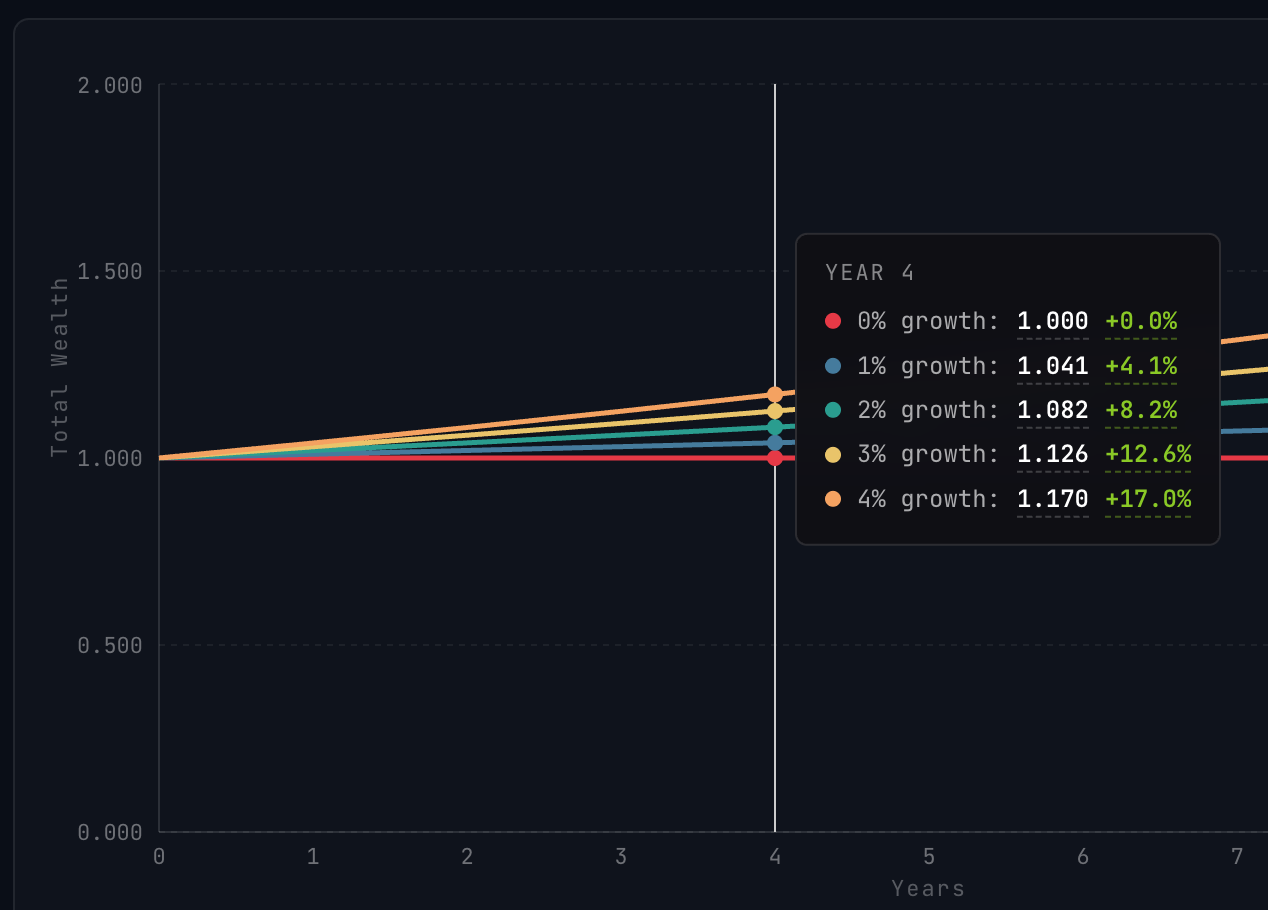
Why is this important? Because local wealth formation drives economic growth. And as I discussed in my previous post Economic Growth is the Best, decreasing wealth formation and economic growth by even a small amount has enormous consequences:
In the image below, you can see the difference that a 1%, 5%, and 10% growth rate make over just five years. You could have 5.1% more in the lowest growth scenario, or 61.1% more in the highest. But clearly anything between them is a premium worth gaining too, because your growth rate today affects your growth rate tomorrow.
Within a four year period, the length of a mayoral and city council term, even a one percentage point decrease in economic growth quickly turns into a big loss. That loss will continue forward as the decreased baseline from which future economic growth can come.
The crucial thing to note here: even if wealthy taxpayers and corporations stay in New York after a tax increase, and even if tax revenues go up as a result, it is possible for the rate of local wealth formation to decrease. These load-bearing individuals and corporations might expand their businesses in other places, invest in goods and property elsewhere, and so on.
A rise in tax receipts without corresponding physical taxpayer loss can mask a larger, worse loss in future aggregate wealth via a decreased rate of wealth formation.
And so what looks like a boon for local tax receipts—keeping the rich people, the corporations, and more of their money—can actually still result in a structural disadvantage for New York relative to other, more business friendly places, and a huge loss in future wealth that would have naturally powered more local activity and tax revenue without higher rates.
“Economic growth rate” is the prize people need to keep their eye on. It is what determines whether New York goes further, faster, and whether it continues to fall behind other states like Texas. Tax rates are a related, but subsidiary, question.
The natural counterpoint to this is that increased tax revenue can be deployed by the government to drive local wealth formation via investments in infrastructure, other public goods, and so forth. Like if the city and state can build more subways, that would naturally increase land values, increase the “opportunity shed” of where people could live and work, and generally expand economic growth and possibility. So perhaps the taxes create a headwind for some private wealth formation, but that is offset by public wealth formation.
This is a good point! I’m not sure how one would design an empirical study to actually figure out whether any one theoretical tax increase would result in offsetting public wealth formation. But my strong suspicion is that New York is not using its already nation-leading tax burden in a sufficiently responsible, wealth generating way that justifies more tax increases.1 The money that it already does have experiences an unfortunately common Second Avenue Subwayification—skyrocketing prices for little or middling results. The most egregious example of this is that New York City spends more than $40,000 per student in the public school system, the highest in the nation, but does not get a commensurate best-in-the-nation result for it.2 And yet New York is being outcompeted by Mississippi (good for Mississippi, of course!), despite funding levels several hundred percent less per pupil than New York.
I am not the first person to notice that monitoring the rate of wealth formation should take a front seat relative to the empirical question of whether new taxes will cause New York taxpayers and corporations to physically leave.
Who’s talking about wealth formation
Josh Greenman wrote an excellent review of New York City’s fiscal outlook a few days ago:
The more important concern isn’t capital flight but wealth formation. As the Citizens Budget Commission has documented, the state’s share of millionaires is shrinking sharply compared to the rest of the nation — not necessarily because of outmigration but because we’re not generating super-wealthy residents like other places are. New York’s share of the nation’s millionaires fell from 12.7% in 2010 to 8.7% in 2022 — a 31% decline that the Citizens Budget Commission estimates cost the state and city more than $13 billion in income tax revenue in 2022 alone. If we don’t get the tax mix right, this phenomenon might continue or accelerate.
Earlier this month, Steven Fulop, the president of the Partnership for New York City, tweeted:
We want to help Mayor @ZohranKMamdani find a real solution. Let’s move past the relocation debate over taxes - people can argue that forever. The real question is simple: if you were starting or scaling a business today, would you choose NYC if these trends continue?
According to the Citizens Budget Commission:
NYC already has the highest combined corporate tax rate in the country at 17.44%.
Matching NJ’s top rate would push NYC to 22.48% — nearly double New Jersey.
That’s a competitiveness problem. Companies may not leave overnight, but they will stop expanding here. This week’s NYC jobs data is a warning sign — and exactly why we’re focused on helping get this right.
And as those two clearly show, the Citizens Budget Commission has been talking about this point and larger questions of city competitiveness for a very long time.
What is that jobs data that Fulop mentioned?
As plenty of people have pointed out, including New York City Comptroller Mark Levine, New York City’s production of jobs would be negative without taxpayer-funded home healthcare jobs, which are also relatively low-wage and don’t pay much back in taxes. Otherwise, 2025 saw a net decrease of 38k jobs, following a years-long downward trend in high wage jobs especially.
For further detail, see the city comptroller’s Annual State of the City’s Economy and Finances 2025, particularly the stark chart below.
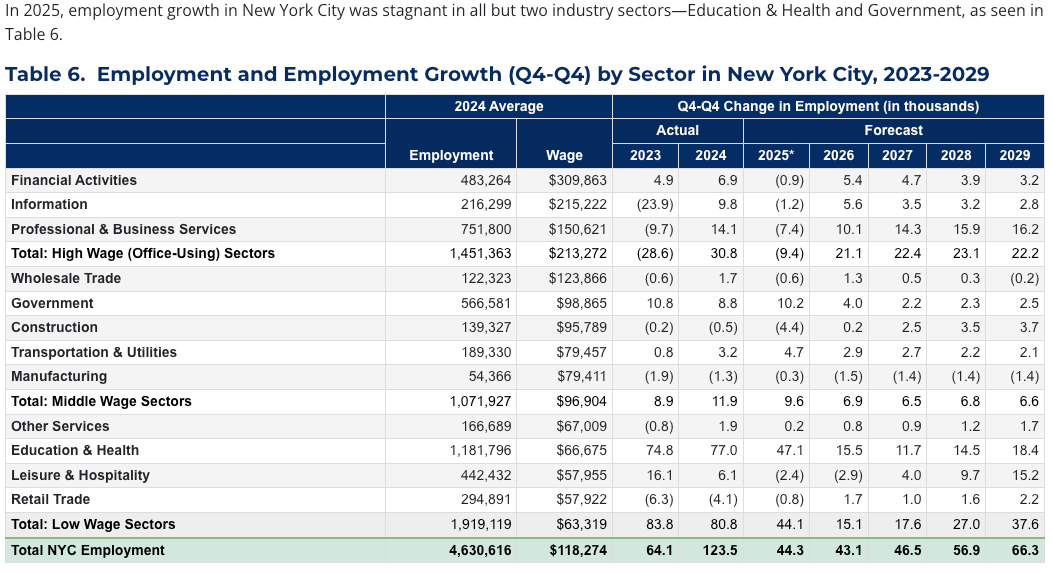
The Citizens Budget Commission puts the issue well here:
New York City’s job recovery and growth has been largely due to more health and social assistance jobs. This represents a two-fold challenge. First, this sector pays wages on the lower end of the spectrum. Second, a large part of the growth has been driven by New York State’s rapidly expanding, Medicaid-funded home care program, which is unaffordable and should be reined in.
Point of reference: when I have discussed this with people, they wonder how hundreds of thousands of jobs could be created with Medicaid funds. The key to understanding this is that New York spends more per capita on Medicaid than any other state. Of the ~$260 billion annual state budget, about $116 billion is Medicaid. Per the state comptroller:
In SFY 2025, federal Medicaid spending totaled $69.2 billion out of a total of $115.6 billion. Total Medicaid spending is projected by the Division of the Budget (DOB) to grow to $133.7 billion in SFY 2029, of which $73.1 billion is expected to be federally funded.
New York’s Medicaid spending per resident, at $4,942, was by far the highest among the 50 states. The second-highest state was Kentucky at $3,989 per resident, and the national average was $2,791 per resident.
Finally: about half of New York City residents are enrolled in Medicaid.
So is the rate of local wealth formation decreasing?
The caution lights are definitely blinking. Between New York’s decreasing rate of formation of millionaires, the bad jobs data, and continually being outcompeted by other states like Texas, the answer seems to be “yes” in some way. (All of the people and families leaving New York are certainly taking massive amounts of skill and capital with them, and a higher tax burden will not help if it’s not spent well.)
More of the political class would do well to pay direct attention to economic growth as an indicator of New York’s health and trajectory, rather than the more culturally distracting, although still important, question of tax rates.
Trajectory matters
The lesson of economic growth is that gains compound over time, so a slightly smaller positive growth rate makes a huge difference. Negative growth rates can get astoundingly bad.
When I was younger, before I had really grown to know and love New York as I do today, I got a copy of A Short History of New York State published by Cornell University Press. It was published in 1957, which turned out to be more of a turning point than its readers might have realized. Later that year, Sputnik achieved orbit and ignited the space race. And New York’s days at the largest state in the union were essentially over. Although it would take a few more years for the Census Bureau to make it official, New York had dropped below quickly growing California, and had further yet to fall.
The second half of the twentieth century was, for New York, a story of interrupted trajectory. For most of the nation’s history we had been the largest state.
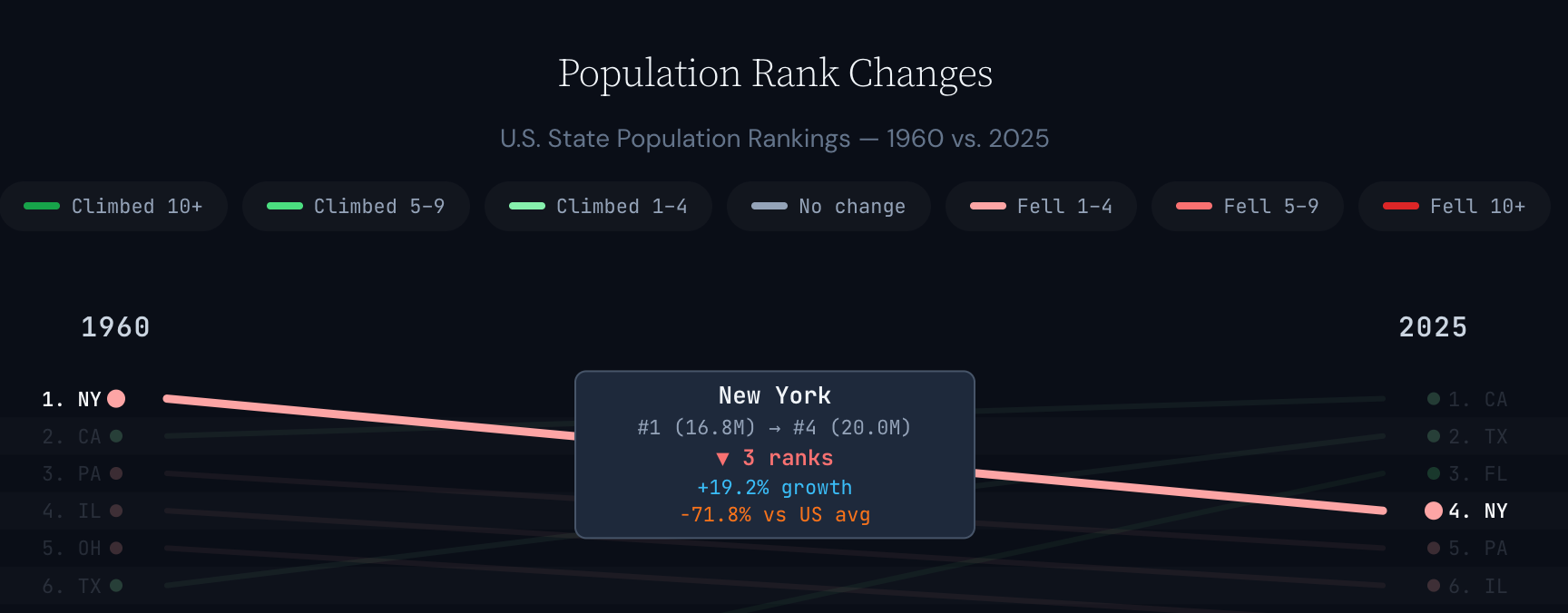
From 1960 through 2025, New York State’s peers in population growth were Iowa and Pennsylvania, which with West Virginia round out the bottom four.

The fastest growing states in that time were to the south and west.

Cities and states that embrace trajectory can completely remake themselves for the better well within one lifetime. New York City’s incumbent advantages, especially its built environment, are great. I would ask elected officials to consider what it could become with a different trajectory. How do you get more oranges, rather than squeezing the one you have even harder?
Post scriptum, on taxes
During this post, and others, I talk about taxpayers in a relatively clinical way, as if they’re just boxes on a spreadsheet. How much do they bring in? How many are there?
When thinking purely in terms of a government budget, this makes sense.
However: taxpayers are also people. When I think about tax policy, I keep that front and center. Every tax dollar taken from a person means they can’t deploy it how they would like in their life, even if they worked hard for it. Ideally, the government has a good reason for spending it instead.
Plenty of people recognize this about taxes, and they treat “the taxpayer” and “the public purse” as serious, morally significant concepts. The public shouldn’t mind paying taxes—even if they’re not thrilled—if they get the public goods they want and need, and the government should take care to spend that money wisely on their behalf. This is the functional version of a social compact.
I do not like any talk or action that threatens the social contract from either end. New York has special trouble with two on the government end at the moment:
A lot of public money is not spent well. It’s the phenomenon of Second Avenue Subwayification.
A contingent of people who talk about “rich people leaving” speak about them like a bully who has cornered their prey. They say “Where else are you going to go? No other place has all the nice things you like!” They hold the incumbent advantages of New York City—density, social graphs, subways, opportunity—hostage in this scenario, often even if they support laws that could not have created those advantages, or would impair them today. I think it’s fine to talk about raising taxes, a taxpayer’s responsibility, a government’s obligation to spend well, all of it—but the way in which one talks about it matters.
There is a larger discussion to have here about tax composition—which taxes are levied, and on who. The property tax system is a good example of a needed revision. Some people’s need to go up, some need to go down. In this piece I am speaking of a more simplified general tax change, and how to think about it relative to the question of wealth formation and economic growth. But it’s definitely possible to bring in a comparable amount of tax revenue with a very different (and better!) set of taxes.
New York City has some of the best individual public schools in the nation, and I don’t want to downplay this. It also provides many quality of life and social services to a diverse population that cost money. This is not “wasted.” But the overall system, for what we pay for it, should be filled with these schools! Even when one accounts for everything the schools do, the expenditure simply is not warranted.