

See the accompanying data post to experiment with simple growth rate models.
After watching city politics for the past month, I keep coming back to the same thought: economic growth, which should be at the center of policymaking, is drifting further to the margins.
So here are some quick thoughts on what I think it is, and why it’s important:
“Economic growth” is a deep and slippery concept that can be tamed
The importance of economic growth will always be underestimated, because it is non-linear
The prize for winning a pie eating contest doesn’t have to be more pie (economic growth is developmental, not merely accumulative)
The challenges of economic growth
Managing transformation
Managing economic parasites
1) “Economic growth” is a deep and slippery concept that can be tamed
Answering “what is economic growth” often gets subtly misanswered as if the question were “what are the metrics of economic growth”? The conversation then immediately turns to discussing whether GDP is a good metric, or many other versions of two people talking past each other. I’ll attempt to sidestep that by explaining myself up front. The concept of economic growth is so large and nuanced that it can seem daunting, but I think you’ll know what I mean at the end of this section.
My base definition of economic growth: It is growth in the economy, which is improvement in the way we live our lives—our work gains us more, and we are able to acquire and use better things; it is a substitution of a less good thing for a better thing. You could put this in terms of production, distribution, consumption, capital, labor, or time. But in my head, the broadest sense of “economic growth” is that the listed items improve when measured against the standard of human flourishing.
Micro- and macroeconomics as a frame: Economic growth could be considered on the individual basis (you get a better job, your company gains market share), or the society-wide basis (your nation has higher incomes, it fosters more innovations). These would be economic growth as seen from the perspective of microeconomics and macroeconomics, respectively. You need to look at both views, which are greater than the sum of their parts.
Political economy as an important conceptual superset: The broad improvements in the capacity of living that characterize economic growth are not isolated. There is no such beast as just the economy. Economies are fundamentally tied to their larger political, cultural, and institutional structures (e.g., government, law, currency, etc). So for me, the phrase “economic growth” generally comes to mean “economic growth, which requires a sufficiently successful co-evolution with the institutions of a society.” This is more like the older term political economy from which economics was extracted. When I discuss economic growth, I draw lines between “public/government” and “private” to isolate concepts for analysis, but I do not ultimately draw lines between them out in the world.
Growth is good. I treat the default, base case of “economic growth” as good. Of course there are bad, suboptimal, or corrupted versions of it, just like there are bad, suboptimal, and corrupted versions of physical human growth (e.g, cancer). But the base case is good, and that’s what I mean unless I say otherwise. Further: (1) it is conceptually proper to assert this good default meaning, and (2) something bad is going on when the people of a society have a default bad view of the phrase “economic growth.”
2) The importance of economic growth will always be underestimated, because it is non-linear
Economic growth does not merely accrete, it compounds. The more you have, the more you get.
I made a comparative economic growth model you can play around with, but it reveals the familiar lesson of compound interest. It also sharply illustrates why a higher economic growth rate is good, and how much a society loses out on by growing at a slower rate than it otherwise could have.
In the image below, you can see the difference that a 1%, 5%, and 10% growth rate make over just five years. You could have 5.1% more in the lowest growth scenario, or 61.1% more in the highest. But clearly anything between them is a premium worth gaining too, because your growth rate today affects your growth rate tomorrow.
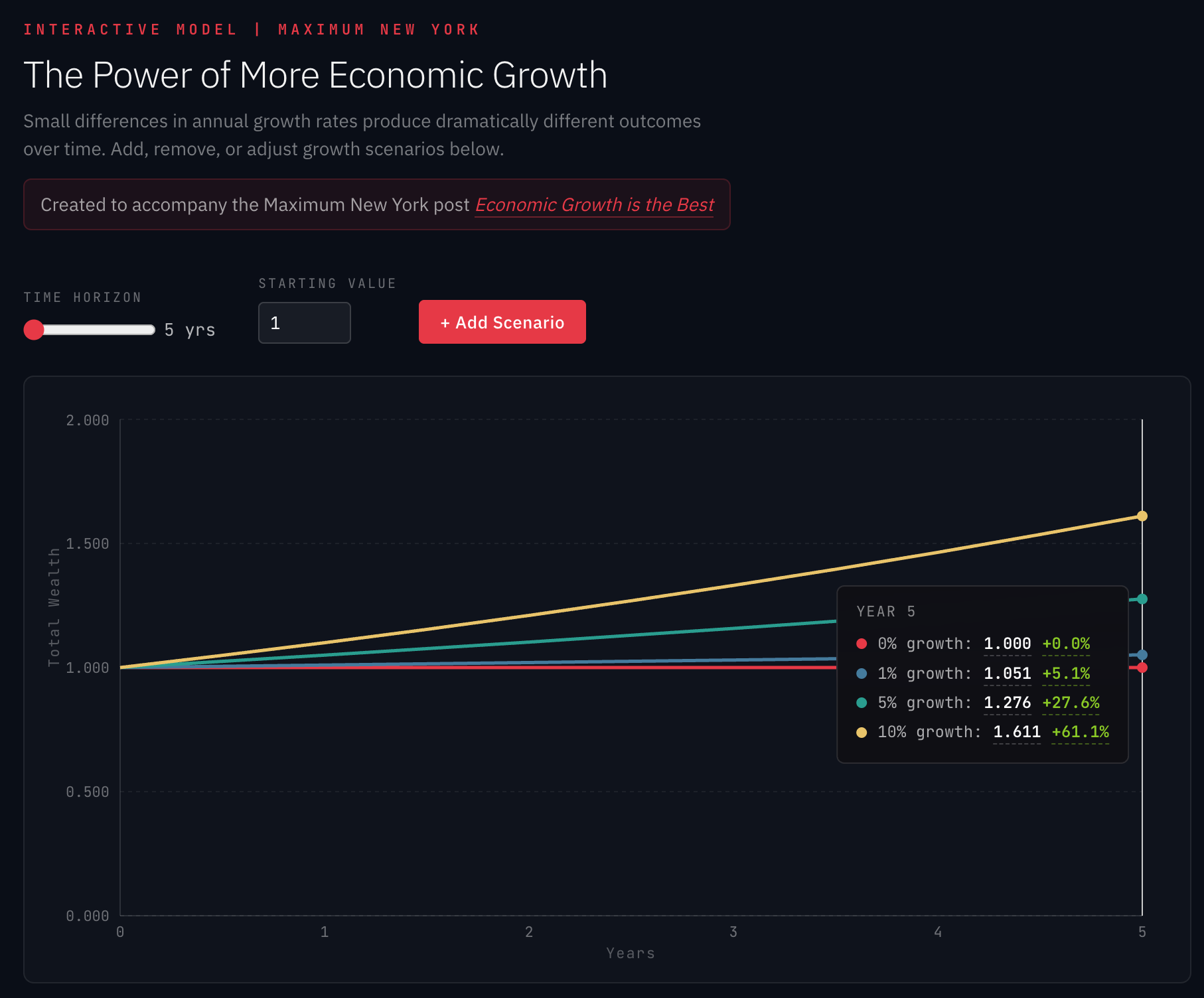
The reality of compounding growth is stark if you ask: “What’s so bad about tolerating a 1% growth rate if you could have more, Daniel? It’s not like you’re losing anything.”
Well—in the chart above, a 10% growth rate over five years got us 61.1% growth. That’s stunning, and society would be getting very rich, very fast if that were happening. This kind of thing has happened in the world.
As the chart below shows, it would take 48 years to get that same 61.1% improvement with a 1% growth rate.
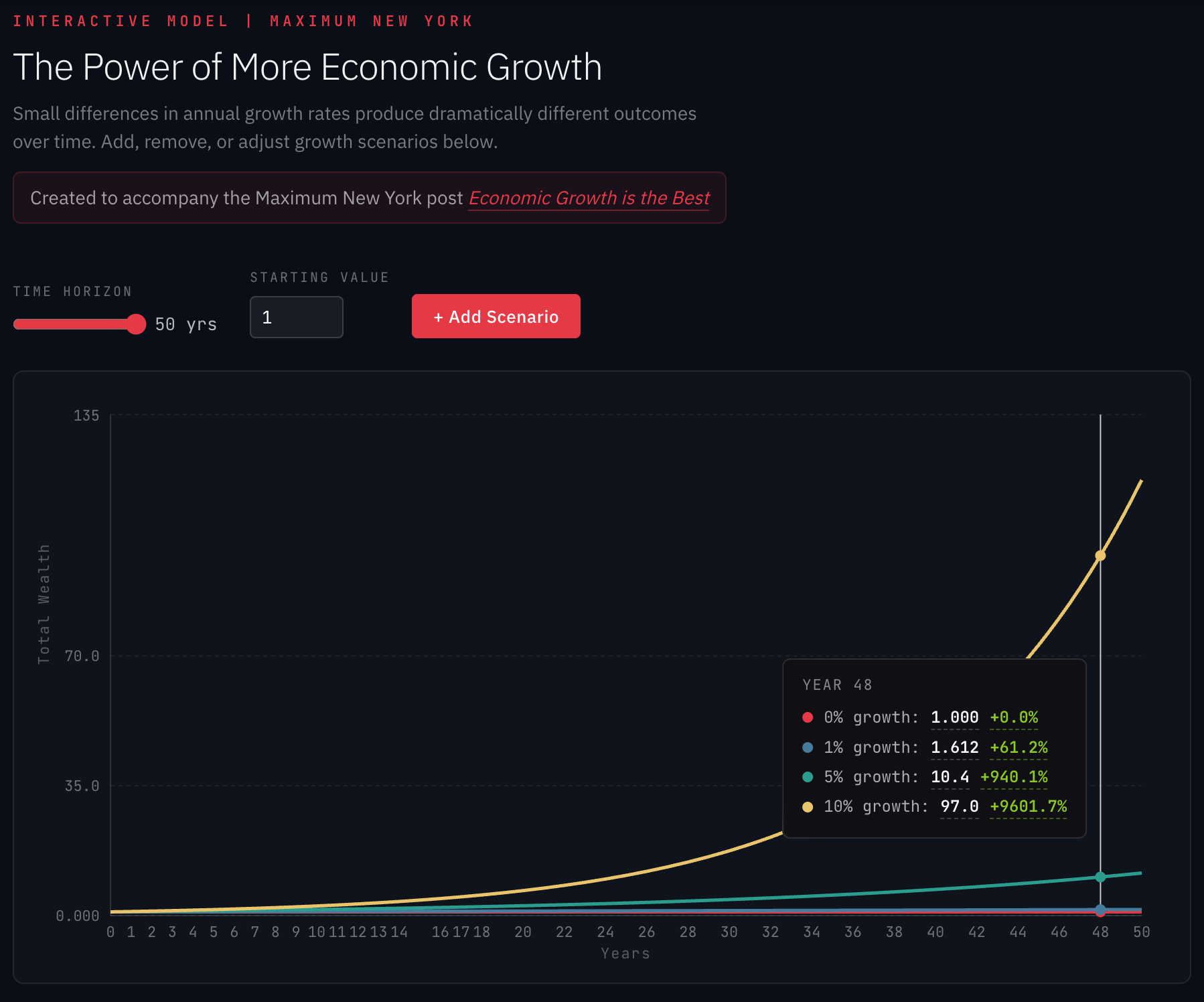
But the differences don’t end there. Every society has some minimum viable growth rate that results in the populace having an experience like “wow, these are good times that we’re in, things are getting steadily better.” If your society experienced a 61.1% jump in economic growth over five years, you’d likely be very happy! You would probably want that to continue, and there would be good arguments for the institutional arrangements that facilitated that growth. Since you “felt the growth,” you’d have a positive default attitude toward it, and would be reluctant to approve of policies or cultural attitudes that could hurt it.1
The opposite is true if you fall below the minimum viable growth rate. At that point, people feel “we should try something different, things just aren’t improving.” And that feeling is not so wrong! In the same way that slow internet is worse than no internet, low economic growth might as well be no growth at all. People do not feel the growth, and so are much more amenable to a default bad view of the concept of economic growth.
My view: on a societal level, one cannot persuade enough people about the value of economic growth with math and charts. This can only be done with a growth rate high enough to make its value viscerally apparent.
Since economic growth is generally an exponential phenomenon, the human mind does not grasp the consequences of it as readily. People think of it as a linear phenomenon, and so wildly underestimate how much and how quickly their lives and society can improve with just a few percentage points more of growth.
We saw this with COVID, which was also exponential. People did not grasp how it could be seemingly nowhere today, and everywhere next week.
But economic growth is good! As a general platform for governance, it is the single most important thing to me, along with respecting a certain kind of rights.2 If someone in a governance position does not have a plan for economic growth, and doesn’t see a dial in their head with the imaginary growth rate created by their policies, I consider it one of the severest defaults they could have.
In his 2018 book Stubborn Attachments, Tyler Cowen lays out the consequences of economic growth well:
Looking into the more distant future makes the question of the economic growth rate all the more important. For instance, a two percent rate of economic growth, as opposed to a one percent rate, makes only a small difference across the time horizon of a single year. But as time passes, the higher growth rate eventually brings about a very large boost to well-being. To make this concrete, here’s an experiment: redo U.S. history, but assume the country’s economy had grown one percentage point less each year between 1870 and 1990. In that scenario, the United States of 1990 would be no richer than the Mexico of 1990.
It is also worth pondering some comparisons with higher rates of economic growth, of the sort we often see in emerging economies. At a growth rate of ten percent per annum, as has been common in China, real per capita income doubles about once every seven years. At a much lower growth rate of one percent, such an improvement takes about sixty-nine years.
Robert E. Lucas, Nobel Laureate in Economics, put the point succinctly: “The consequences for human welfare involved in questions like these are staggering: once one starts to think about [exponential growth], it is hard to think about anything else.”
Even if you don’t regard material wealth as central to human well-being, economic growth brings many other values, including, for instance, much greater access to the arts and education. Economic growth also gives individuals greater autonomy and minimizes the chance that their destiny will be determined by the time and place in which they were born (pp.40-41).
3) The prize for winning a pie eating contest doesn’t have to be more pie
If you’ve worked in a certain part of the corporate world, you might have heard the phrase “The prize for winning the pie eating contest…is more pie.” It’s what someone wearily says as they accept another load of work right after a busy season, or what they say to you as they drop that load of work on your desk instead.
Culturally, most people speak as though this is true about economic growth—it’s purely a phenomenon of getting more pie, or “growing the pie.” More of the same.
This is an accumulative view of wealth. But economic growth requires a developmental view.
For example: economic growth doesn’t just result in you having more money in your bank account, or just more of the consumer goods that are available. It results in a different society with different options. It’s not growing the pie, it’s substituting it for a whole other food.
It means having the option to buy something today that you couldn’t have had at any price yesterday. It is why You Are Richer than John D. Rockefeller.
You can get a feel for the “more pie” error by thinking about past visions of the future. For example, one might have thought we’d have wildly better communication in the future, because we could write a letter and send it into a vast system of pneumatic tubes to its recipient. The actual reality of future communication was not just “more pneumatic tubes.” It was the internet and modern phones.3
The “grow the pie” vision of economic growth and old science fiction both make the mistake of projecting the present into the future incorrectly. One must instead imagine how the future will developmentally grow out of the present.
But the pie fallacy isn’t just limited to view of economic growth. It applies to decay as well. If you have a negative growth rate, you won’t just have less of what you have today at higher prices. Many things might just cease to exist, and your society will change in big ways (see The Foundation Effect). You might, unfortunately, become as rich as John D. Rockefeller.
Ezra Klein and Derek Thompson nailed the incorrectness of the “economy as pie” metaphor in the introduction to their 2025 book Abundance:
Perhaps you’ve heard the cliché that the economy is a pie we must grow rather than slice. It is hard to know where to begin with what this image gets wrong, because it gets almost nothing right. If you somehow grew a blueberry pie, you’d get more blueberry pie. But economic growth is not an addition of sameness. The difference between an economy that grows and an economy that stagnates is *change*. When you grow an economy, you hasten a future that is different. The more growth there is, the more radically the future diverges from the past. We have settled on a metaphor for growth that erases its most important characteristic.
[…]
Imagine going to sleep in 1875 in New York City and waking up thirty years later. As you shut your eyes, there is no electric lighting, Coca-Cola, basketball, or aspirin. There are no cars or “sneakers.” The tallest building in Manhattan is a church. When you wake up in 1905, the city has been remade with towering steel-skeleton buildings called “skyscrapers.” The streets are filled with novelty: automobiles powered by new internal combustion engines, people riding bicycles in rubber-soled shoes—all recent innovations. The Sears catalog, the cardboard box, and aspirin are new arrivals. People have enjoyed their first sip of Coca-Cola and their first bite of what we now call an American hamburger. The Wright brothers have flown the first airplane. When you passed into slumber, nobody had taken a picture with a Kodak camera or used a machine that made motion pictures, or bought a device to play recorded music. By 1905, we have the first commercial versions of all three—the simple box camera, the cinematograph, and the phonograph.
Now imagine dozing off for another thirty-year nap between 1990 and 2020. You would wonder at the dazzling ingenuity that we funneled into our smartphones and computers. But the physical world would feel much the same. This is reflected in the productivity statistics, which record a slowing of change as the twentieth century wore on. This is not just a problem for our economy. It is a crisis for our politics. The nostalgia that permeates so much of today’s right and no small part of today’s left is no accident. We have lost the faith in the future that once powered our optimism. We fight instead over what we have, or what we had.
[…]
It is routine in politics to imagine a just present and work backward to the social insurance programs that would get us there. It is equally important to imagine a just—even a delightful—future and work backward to the technological advances that would hasten its arrival. Bastani’s vision is bracing because it insists that those of us who believe in a fairer, gentler, more sustainable world have a stake in bringing forward the technologies that will make that world possible. That is a political question as much as a technological one: those same technologies could become accelerators of inequality and despair if they’re not embedded in just policies and institutions (pp.11-13).
4) Economic growth is a front in the meme wars
To some people, the phrase “economic growth” means some version of “spiking short term gains for the few at the long term expense of the many.” Or it means “the rich get richer, but not anyone else.” Or it means “the government has no role at all here.” You will find people who harm the healthy concept of economic growth all across the political spectrum.
In other words, they conflate a bad or incomplete version of economic growth with the whole concept.
It’s this conceptual move:
Person A: My son is growing, how wonderful!
Person B: You’re a monster. Why do you want him to have cancer?
Person A [putting down their child’s doctor report]: What.
Person B asserts a default bad definition of “human growth” here that seems absurd in context, but this kind of absurdity really does exist with regard to the concept of economic growth. It is often a memetic response against the words “economic growth.”
And this memetic response against the phrase “economic growth” often grows into a general flinch against private initiative in some quarters. For others who have a differently incorrect version of the term, it becomes a flinch against public initiative.
Untangling these conversations requires taking a step back and clarifying what everyone means.
In the political arena, it often just means being brave enough to defend proper economic growth in public in the first place.
5) The challenges of economic growth
Managing transformation
Since economic growth is not merely more of the same, but transformational, it will present challenges to incumbent societal institutions. People might flip to the new way of doing things without thinking about any potential babies in the bathwater.
I don’t think this means avoiding economic growth, because the status quo has its own set of dangers. It is not a safe default by any means, and it can always yield to decay instead of growth. One must simply be mindful.
Economic growth requires innovation in cultural and political institutions to succeed, as well as a careful conservatism when relevant. To use another human growth analogy: as people grow, they go through several important transformations like puberty or parenthood. A person is fundamentally different on either side of those transformations, and must change to carry them off successfully. Not everyone does.
Managing economic parasites
Besides the raw challenge of managing transformation, economic growth also produces surpluses that can attract economic parasites that wind up killing, or severely diminishing the host. There are several versions of this:
Version one: Matt Yglesias wrote about this phenomenon in The stationary bandits of New York City (June 2025). Stationary bandits set themselves up to extract rent from an economy, and in the process block what would otherwise be superior economic growth. Anyone or any institution can become a rentier in this fashion: individuals, companies (non-profit and for-profit), governments, and more.
Version two: wealth can facilitate sloth, and it can facilitate a kind of material security that makes people forget how load bearing certain norms and institutions are; they become too willing to tear things down. Culture is the medium that determines whether large-scale wealth is productively channeled. Figuring out how to get around these blocks, or stopping them from forming, is an essential cultural and political task in the realm of political economy.
6) Excelsior
If we want to live up to New York’s state motto, economic growth must move to the center of the policy agenda.
Although human culture is strange, and of course there are exceptions here.
This is broadly where Tyler Cowen lands in Stubborn Attachments. I would say he persuaded me, but I was essentially on board with the idea when I read his book. He made my dedication to this view sharper.
This was a grounding piece for me, many of the loosely terms ideas that I had about economic growth and also confusions I ignored (such as confusing about how the pie grows) have been illuminated. Much appreciated!
This was generative to me. Will share some thoughts as they crystallize.