

“Why don’t the best and brightest go into government?” Someone expresses this sentiment to me at least once a week. My general response has four parts:
For many reasons that vary depending on which government you’re talking about exactly (local, state, federal—and which parts of each of those?).
There are actually many talented people working in government.
There are not nearly enough talented people working in government.
The idea that “talented people don’t go into government” is as old as America itself. It is not a new phenomenon.
This post explores the fourth point by reviewing two classic works: Alexis de Tocqueville’s Democracy in America (1835, 1840) and James Bryce’s The American Commonwealth (1888). Both were keen European observers of America, and both delivered their observations to posterity at length in a book.
And both had quite a lot to say about “why the best people do not go into politics.”
This post, with a few obvious exceptions, is not making any direct claims about talent in politics. My goal is to lay out what Tocqueville and Bryce said, and to show, through a bit of history and storytelling, that this is an old question.
And if it’s an old question, then America has managed quite a lot despite a persistent structural problem. I hope Tocqueville and Bryce can give you some good ideas or inspiration for our future.
Table of Contents:
Alexis de Tocqueville on the quality of American politicians
Alexis de Tocqueville on the quality of American politicians
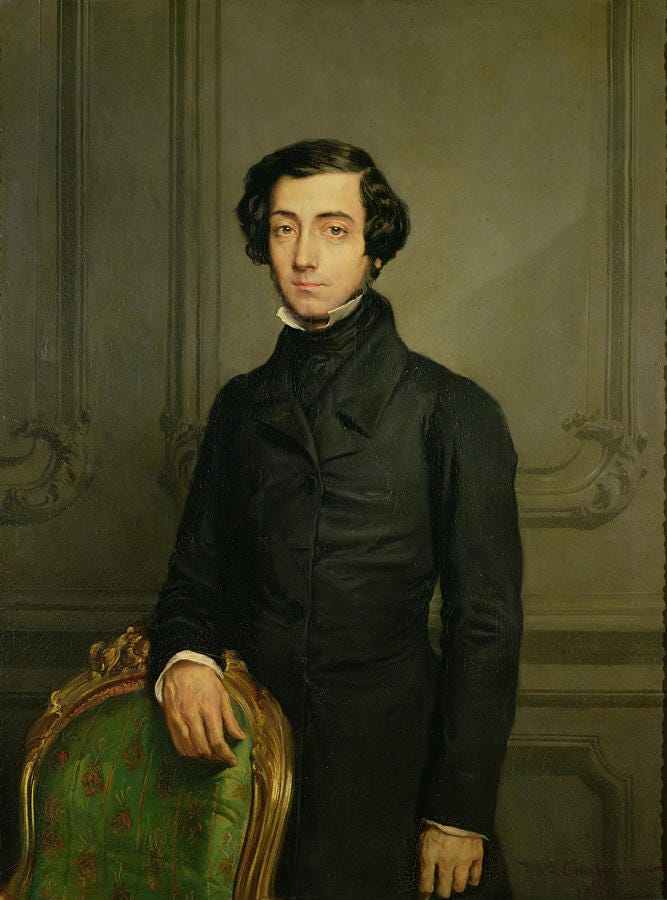
Alexis de Tocqueville (1805-59) was a French historian, politician, and political philosopher. He traveled throughout the United States (and Canada) for nine months in 1831 and 1832, and the distilled product of those travels was Democracy in America (volume one, 1835; volume 2, 1840). It is a sweeping commentary on the America of ~1831, and Tocqueville centers one key observation throughout (emphasis added):
Among the new objects that attracted my attention during my stay in the United States, none struck my eye more vividly than the equality of conditions. I discovered without difficulty the enormous influence that this primary fact exerts on the course of society; it gives a certain direction to public spirit, a certain turn to the laws, new maxims to those who govern, and particular habits to the governed. (3)
In volume one, part two, chapter five, Tocqueville declines to hedge on the question of high quality individuals in American government:
On my arrival in the United States, I was struck with surprise to discover the extent to which merit was common among those who were governed and how little there was among those who governed… (188)
He goes on to contrast the present that he observed during his trip with the era of the American founding:
It is a constant fact that in our day, in the United States, the most remarkable men are rarely called to public offices, and one is obliged to recognize that it has been so to the degree that democracy has passed beyond all its former limits. It is evident that the race of American statesmen has shrunk singularly in a half century. (188)
What could be the cause of this decline in American statesmen? Tocqueville offers many explanations, and I’m going to focus on four of them:
1) People are too busy to properly evaluate candidates
People are busy living their lives, and they don’t have time to properly evaluate the candidates for office. As a result, they vote based on superficial things, and they are fooled by hucksters with cheap tricks.
What long study, what diverse notions are necessary in order to get for oneself an exact idea of the character of a single man!…The people never find the time and means to engage in this work. They must always judge in haste and attach themselves to the most salient objects. Hence charlatans of all kinds know so well the secret of pleasing them, whereas most often their genuine friends fail at it. (189)
When commenting on Congress, Tocqueville says: “When you enter the House of Representatives in Washington, you feel yourself struck by the vulgar aspect of this great assembly. Often the eye seeks in vain for a celebrated man within it” (191). This reminded me of a scene from the HBO series Veep, where former President Meyer is trying to find Congressional votes for a lobbyist: “And if you don’t find anyone in the Senate, lift up the sewer grate to the House.”1
2) People do not like those who are conspicuously better than themselves
People are often not fond of those who are obviously better than themselves. And while Americans don’t display the more extreme nature of this attitude that prevails elsewhere, their default does not favor their betters:
…it is not always the capacity that democracy lacks for choosing men of merit, but the desire and the taste. One must not conceal from oneself that democratic institutions develop the sentiment of envy in the human heart to a very high degree…Democratic institutions awaken and flatter the passion for equality without ever being able to satisfy it entirely…All that surpasses them, in whatever place, then appears to them as an obstacle to their desires, and there is no superiority so legitimate that the sight of it does not tire their eyes. (189)
3) “The best” don’t want to put up with holding office, and the opportunity cost is too great
Those who are best qualified to run the government will not subject themselves to that which is required to hold those offices.
While the natural instincts of democracy bring the people to keep distinguished men away from power, an instinct no less strong brings the latter to distance themselves from a political career, in which it is so difficult for them to remain completely themselves and to advance without debasing themselves. (189)
They also do not want to go into government when they can (usually) do much better for themselves outside of it (emphasis added):
It results from this that in times of calm, public offices offer little lure for ambition. In the United States, it is people moderate in their desires who involve themselves in the twists and turns of politics. Great talents and great passions generally turn away from power in order to pursue wealth; and it often happens that one takes charge of directing the fortune of the state only when one feels oneself barely capable of conducting one's own affairs.
It is to these causes as much as to the bad choices of democracy that one must attribute the great number of vulgar men who occupy public offices. In the United States, I do not know if the people would choose superior men who might solicit their votes, but it is certain that such men do not solicit them. (195)
He then goes on to quote prominent New York jurist James Kent. Writing about the American tendency to appoint judges rather than elect them, Kent says:
The fittest men would probably have too much reservedness of manners, and severity of morals, to secure an election resting on universal suffrage.2
However, lest someone get an overly narrow or Aristocratic view of Tocqueville, he also has this to say about judges:
When I see certain magistrates among us being brusque with parties or addressing them with witticisms, shrugging their shoulders at the means of the defense and smiling complacently at the enumeration of charges, I would like to have someone try to remove their robes in order to discover if, being now clothed as simple citizens, that would not recall them to the natural dignity of the human species. (194)
This reflects a broader appreciation for American culture that Tocqueville expresses throughout Democracy in America, and I wouldn’t want any readers to think the excerpts that I have here represent the totality of Tocqueville’s views. For example, as much as he laments the “lack of talent in government,” he also has this to say:
Officials themselves sense perfectly well that they have only obtained the right to be placed above others by their power on the condition that they descend to the level of all by their manners. I can imagine no one more plain in his way of acting, more accessible to all, more attentive to requests, and more civil in his responses than a public man in the United States. I like this natural style of the government of democracy; in the internal force that is attached more ot the office than to the official, more to the man than to the external signs of power, I perceive something of virility that I admire. (194)
4) Circumstances do not demand that the best step forward
Circumstances in the 1830s did not demand the best of Americans according to Tocqueville, unlike the Revolution, which broke the usual suspicions between “the people” and “the best of the people” (points two and three above). Tocqueville explains that extreme circumstances will either cause the best to rise to the top of a nation, or destroy it for lack of the same (emphasis added below):
When great perils threaten the state, one often sees the people fortunately choose the most appropriate citizens to save it. It has been remarked that when a danger presses, man rarely remains at his habitual level; he elevates himself well above or falls below. So does it happen to peoples themselves...But it is more common to see, among nations as among men, extraordinary virtue born of the very imminence of danger. Then great characters appear in relief, like monuments hidden by the obscurity of night that one sees suddenly outlined by the light of a fire…But such events are rare; it is by the ordinary pace of things that one must judge. (189-190)
In his commentary on Democracy in America, English philosopher (and economist, and so much more) John Stuart Mill approves of Tocqueville’s analysis, saying (emphasis added):
The truth is that great talents are not needed for carrying on, in ordinary times, the government of an already well-ordered society. In a country like America little government is required: the people are prosperous, and the machinery of the state works so smoothly, by the agency of the people themselves, that there is next to nothing for the government to do. When no great public end is to be compassed; when no great abuse calls for remedy, no national danger for resistance, the mere everyday business of politics is an occupation little worthy of any mind of first-rate powers, and very little alluring to it. In a settled state of things, the commanding intellects will always prefer to govern mankind from their closets, by means of literature and science, leaving the mechanical details of government to mechanical minds.
In national emergencies, which call out the men of first-rate talents, such men always step into their proper place…
I’ll note that I disagree with Mill’s characterization of Tocqueville’s view. Tocqueville only said that emergencies provide the opportunity for great men to take the helm of state, but it was by no means assured. Mill assumes that political talent will find its level. Further: Mill greatly underestimates the need of “first-rate powers” during non-emergency times! Proper maintenance of government requires excellence too. Without it, the ship of state rusts out into an emergency (indeed, Bryce contemplates this very phenomenon). And even absent an emergency, an ambitious person might train their effort upon tearing down a nation to rebuild it in their image (see the following footnote for Lincoln’s discussion of this prospect).3
» A side note: Maintenance: Of Everything, Part One (2026) from Stripe Press, by Steward Brand, is a great meditation and study on maintenance generally. You can read the book as it takes further shape here.
James Bryce surveys the commonwealth
.jpg)

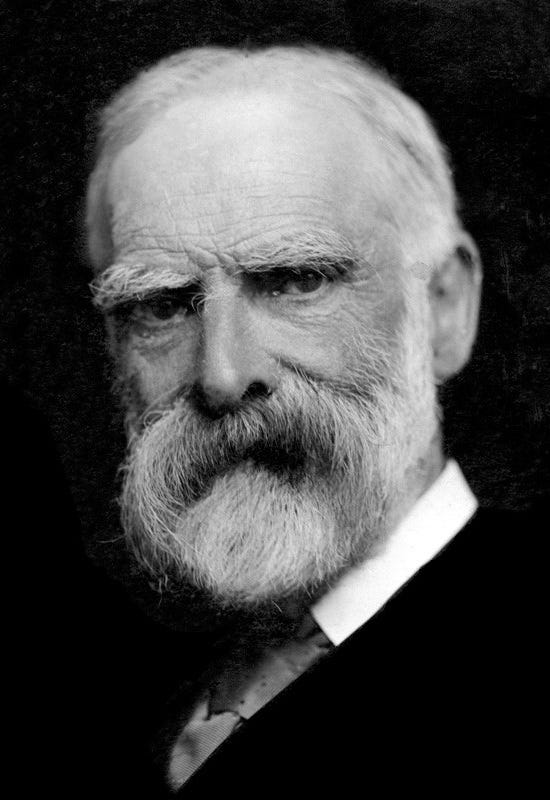
While many have heard the name Alexis de Tocqueville and know of Democracy in America, far fewer have heard of James Bryce and his work The American Commonwealth. Bryce (1838-1922) was a British observer of America, in addition to being a member of Parliament, a historian, and eventually the UK’s ambassador to the US.
He, like Tocqueville, spent about nine months traveling throughout the United States prior to his book’s publication, although Bryce traveled several times from 1870 to 1883, and published in 1888. The America that he observed was quite different from Tocqueville’s; not only was it well into industrialization, but its forms of government had evolved and matured. The Civil War was done, and slavery was ended.
Nonetheless, and despite their differences, the two both dealt with the quality of American politicians. Indeed, Democracy in America and The American Commonwealth resemble each other more than one might expect.
The title of this essay is, in fact, an adaptation of chapter 58 of The American Commonwealth, “Why the Best Men Do Not Go Into Politics.” My summary collection of Bryce’s thoughts on American politicians are primarily pulled from the aforementioned and chapter 8, “Why Great Men Are Not Chosen Presidents.” To wit:
1) People do not prize those who are conspicuously better than themselves
…the ordinary American voter does not object to mediocrity…He likes his candidate to be sensible, vigorous, and, above all, what he calls “magnetic,” and does not value, because he sees no need for, originality or profundity, a fine culture or a wide knowledge. Candidates are selected to be run for nomination by knots of persons who, however expert as party tacticians, are usually commonplace men…It must also be remembered that the merits of a president are one thing and those of a candidate another thing. (71)
2) “The best” don’t want to put up with holding office, and the opportunity cost is too great
Bryce broadly lays out the challenges as social and vocational.
The social costs of holding office
The want of a social and commercial capital is such a cause. To be a federal politician you must live in Washington, that is, abandon your circle of home friends, your profession or business, your local public duties. But to live in Paris or London is of itself an attraction to many Englishmen and Frenchmen. (744)
The fascination which politics have for many people in England is largely a social fascination. Those who belong by birth to the upper classes like to support their position in county society by belonging to the House of Commons, or by procuring either a seat in the House of Lords, or the lord-lieutenancy of their county, or perhaps a post in the royal household. The easiest path to these latter dignities lies through the Commons. Those who spring from the middle class expect to find by means of politics an entrance into a more fashionable society than they have hitherto frequented. Their wives will at least be invited to the party receptions, or they may entertain a party chieftain when he comes to address a meeting in their town. Such inducements scarcely exist in America. A congressman, a city mayor, even a state governor, gains nothing socially by his position. There is indeed, except in a few large cities with exclusive sets, really nothing in the nature of a social prize set before social ambition, while the career of political ambition is even in those cities wholly disjoined from social success. The only exception to this rule occurs in Washington, where a senator or cabinet minister enjoys ex officio a certain social rank. (746)
The vocational costs of holding office: less interesting and less remunerative work
Less interesting:
Politics have been since the Civil War less interesting or at any rate less exciting, than they have in Europe during the same period. The two kinds of questions which most attract eager or ambitious minds, questions of foreign policy and of domestic constitutional change, were generally absent, happily absent. (745)
The division of legislative authority between the federal Congress and the legislatures of the states further lessens the interest and narrows the opportunities of a political career…The limited sphere of each body deprives it of the services of many active spirits who would have been attracted by it had it dealt with [all] sets of matters, or with the particular set of matters in which their own particular interest happens to lie. (745-746)
Less remunerative, less able to absorb ambition:
In America there are more easy and attractive openings into other careers than in most European countries. The development of the great West, the making and financing of railways, the starting of industrial or mercantile enterprises in the newer states, offer a tempting field to ambition, ingenuity, and self-confidence. A man without capital or friends has a better chance than in Europe, and as the scale of undertakings is vaster, the prizes are more seductive. Hence much of the practical ability which in the Old World goes to parliamentary politics or to the civil administration of the state, goes in America into business, especially into railways and finance. No class strikes one more by its splendid practical capacity than the class of railroad men. It includes administrative rulers, generals, diplomats, financiers, of the finest gifts. And in point of fact (as will be more fully shown later) the railroad kings have of late years swayed the fortunes of American citizens more than the politicians. (746)
Interestingly, however, Bryce goes out of his way to contend that the harsh treatment of public officials by the press, and by society in general, is not a reason for a lack of quality men in American politics:
It may however be alleged that I have omitted one significant ground for the distaste of “the best people” for public life, viz., the bad company they would have to keep, the general vulgarity of tone in politics, the exposure to invective or ribaldry by hostile speakers and a reckless press.
I omit this ground because it seems insignificant. In every country a politician has to associate with men whom he despises and distrusts, and those whom he most despises and distrusts are sometimes those whose so-called social rank is highest—the sons or nephews of great nobles. In every country he is exposed to misrepresentation and abuse, and the most galling misrepresentations are not the coarse and incredible ones, but those which have a semblance of probability, which delicately discolour his motives and ingeniously pervert his words. A statesman must soon learn, even in decorous England or punctilious France or polished Italy, to disregard all this, and rely upon his conscience for his peace of mind, and upon his conduct for the respect of his countrymen. If he can do so in England or France or Italy, he may do so in America also…I could not learn the name of any able and high-minded man of whom it could be truly said that through this cause his gifts and virtues had been reserved for private life. The roughness of politics has, no doubt, some influence on the view which wealthy Americans take of a public career, but these…are not the class most inclined anyhow to come to the front for the service of the nation. (747)
3) The party machine system
One large difference between Bryce and Tocqueville is their treatment of political parties. Bryce dedicated quite a lot of analysis to how able men succeeded and failed within the party system, which he called a “Slough of Despond.”
From the introduction to The American Commonwealth:
The differences between Democracy in America and The American Commonwealth are immediately seen…on political parties, Tocqueville provided yet another single chapter, and this no more than 6 pages. Bryce, on the other hand, offered twenty-three chapters totalling 243 pages. (Introduction, xvii)
Bryce is convicted:
Far more weight [than the difficulties of public life] is to be laid upon the difficulties which the organization of the party system, to be described in the following chapters, throws in the way of men who seek to enter public life. There is, as we shall see, much that is disagreeable, much that is even humiliating, in the initial stages of a political career, and doubtless many a pilgrim turns back after a short experience of this Slough of Despond. (748)
If you read Bryce enough, you come to see that “professional politician” was an epithet when he said it. It denoted someone of lesser ability who saw the political arena as a career for personal gain, as opposed to the view that many of the Founders had of a virtuous man who would occasionally take office when needed, and then, like Cincinnatus, return to private life. This echoes Democracy in America above: “and it often happens that one takes charge of directing the fortune of the state only when one feels oneself barely capable of conducting one’s own affairs” (190).
If the path to Congress and the state legislatures and the higher municipal offices were cleared of the stumbling blocks and dirt heaps which now encumber it, cunningly placed there by the professional politicians [and their party machines], a great change would soon pass upon the composition of legislative bodies, and a new spirit be felt in the management of state and municipal as well as of national affairs. (748)
No man stands long before the public and bears a part in great affairs without giving openings to censorious criticism. Fiercer far than the light which beats upon a throne is the light which beats upon a presidential candidate, searching out all the recesses of his past life. Hence, when the choice lies between a brilliant man and a safe man, the safe man is preferred. Party feeling, strong enough to carry in on its back a man without conspicuous positive merits, is not always strong enough to procure forgiveness for a man with positive faults. (70)
4) Circumstances do not demand that the best step forward
Broadly, Bryce subscribes to a similar “great man” theory of politics as Tocqueville. He thinks that great national emergencies are a potential magnet for generational political talent, and he notes both the Founding Era and the Civil War as containing this caliber of American politician.
However, he says, the post-Civil War America that he personally observed had created a political lull where high-quality men left the political arena to the lesser “professional politicians,” who had, for lack of proper maintenance, created a situation that once again required great talent:
To explain the causes which keep so much of the finest intellect of the country away from national business is one thing, to deny the unfortunate results would be quite another. Unfortunate they certainly are. But the downward tendency observable since the end of the Civil War seems to have been arrested. When the war was over, the Union saved, and the curse of slavery gone forever, there came a season of contentment and of lassitude. A nation which had surmounted such dangers seemed to have nothing more to fear. Those who had fought with tongue and pen and rifle, might now rest on their laurels. After long-continued strain and effort, the wearied nerve and muscle sought repose. It was repose from political warfare only. For the end of the war coincided with the opening of a time of swift material growth and abounding material prosperity, in which industry and the development of the West absorbed more and more of the energy of the people. Hence a neglect of the details of politics by the better class of voters such as had never been seen before. Later years have brought a revival of interest in public affairs, and especially in the management of cities. There is more speaking and writing and thinking, practical and definite thinking, upon the principles of government than at any previous epoch… (748)
And, even beyond the particular “revival of interest” Bryce was observing, he also makes sure to tell his reader that there are, in fact, able politicians throughout America. He shares the view that I mentioned at the top of this piece—that there are plenty of talented people in government, and also still not enough:
…the arena is not wholly left to the professionals. Both the federal and the state legislatures contain a fair proportion of upright and disinterested men, who enter chiefly, or largely, from a sense of public duty, and whose presence keeps the mere professionals in order. So does public opinion, deterring even the bad men from the tricks to which they are prone, and often driving them, when detected in a serious offense, from place and power. (743)
Bryce also notes that presidential talent specifically waxes and wanes, and cut American history up until the time of The American Commonwealth’s publication into three eras of talent:
Let us close by observing that the presidents, regarded historically, fall into three periods, the second inferior to the first, the third rather better than the second.
Down till the election of Andrew Jackson in 1828, all the presidents had been statesmen in the European sense of the word, men of education, of administrative experience, of a certain largeness of view and dignity of character. All except the first two had served in the great office of secretary of state; all were known to the nation from the part they had played. In the second period, from Jackson till the outbreak of the Civil War in 1861, the presidents were either mere politicians, such as Van Buren, Polk, or Buchanan, or else successful soldiers, such as Harrison or Taylor, whom their party found useful as figureheads. They were intellectual pygmies beside the real leaders of that generation—Clay, Calhoun, and Webster. A new series begins with Lincoln in 1861. He and General Grant, his successor, who cover sixteen years between them, belong to the history of the world. The other less distinguished presidents of this period contrast favourably with the Polks and Pierces of the days before the war, if they are not, like the early presidents, the first men of the country. If we compare the twenty presidents who were elected to office between 1789 and 1900 with the twenty English prime ministers of the same period, there are but six of the latter, and at least eight of the former whom history calls personally insignificant, while only Washington, Jefferson, Lincoln, and Grant can claim to belong to a front rank represented in the English list by seven or possibly eight names. It would seem that the natural selection of the English parliamentary system, even as modified by the aristocratic habits of that country, had more tendency to bring the highest gifts to the highest place than the more artificial selection of America. (74-75)
A Fractal Conclusion
Both Democracy in America and The American Commonwealth are sprawling epics.
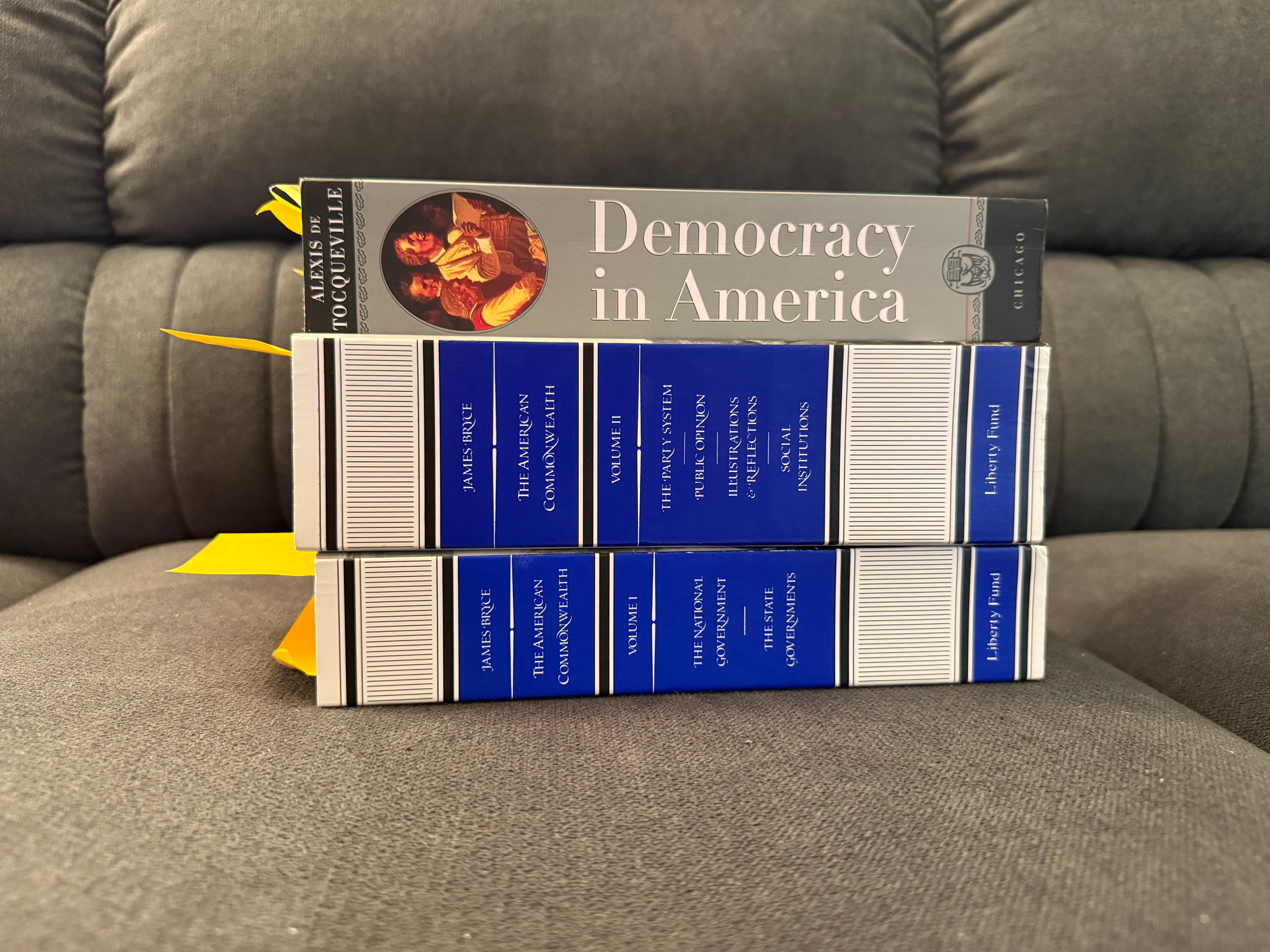
Knowing that, any reader of this post should hesitate to extrapolate grand theories about the books based on my excerpts of them. They do not begin to tell the story of how Tocqueville and Bryce thought about America, a country they both greatly admired. I find myself in kind of a fractal situation here: I am trying to explain the difficulty of communicating a proper view of these books, just as both Tocqueville and Bryce tried to impress upon their audiences the difficulty of communicating a proper view of America itself.
And so I’ll end with an excerpt from Bryce, in the introduction to The American Commonwealth:
…I will say that [the United States] make on the visitor an impression so strong, so deep, so fascinating, so inwoven with a hundred threads of imagination and emotion, that he cannot hope to reproduce it in words, and to pass it on undiluted to other minds. With the broad facts of politics it is otherwise. These a traveller can easily set forth, and is bound in honesty to set forth, knowing that in doing so he must state much that is sordid, much that will provoke unfavourable comment. The European reader grasps these tangible facts, and, judging them as though they existed under European conditions, draws from them conclusions disparaging to the country and the people. What he probably fails to do, because this is what the writer is most likely to fail in enabling him to do, is to realize the existence in the American people of a reserve of force and patriotism more than sufficient to sweep away all the evils which are now tolerated, and to make the politics of the country worthy of its material grandeur and of the private virtues of its inhabitants. America excites an admiration which must be felt upon the spot to be understood. The hopefulness of her people communicates itself to one who moves among them, and makes him perceive that the graver faults of politics may be far less dangerous there than they would be in Europe. A hundred times in writing this book have I been disheartened by the facts I was stating; a hundred times has the recollection of the abounding strength and vitality of the nation chased away these tremors. (8-9)
Sources consulted and mentioned:
Principal:
Tocqueville, Alexis de. Democracy in America. Translated by Harvey C. Mansfield and Delba Winthrop. United States: University of Chicago Press, 2012 (originally published as two volumes in 1835 and 1840).
Bryce, James. The American Commonwealth, Indianapolis: Liberty Fund, 1995. Vols. 1 and 2 (originally published in 1888, with multiple updates through 1920).
Supplemental:
Brand, Stewart. The Maintenance of Everything: Part One, Stripe Press, 2026.
Kent, James. Commentaries on American Law. New York: O. Halsted, 1826.
Lincoln, Abraham. “The Perpetuation of Our Political Institutions: Address Before the Young Men’s Lyceum of Springfield, Illinois,” 1838.
Mill, John. The Collected Works of John Stuart Mill, Volume XVIII - Essays on Politics and Society Part I, “De Tocqueville on Democracy in America [I],” University of Toronto Press, 1977.
Commentaries on American Law, Part 2, Lecture 14, p.273 (1826). Tocqueville’s original French rendition of this excerpt, when rendered back into English by the translators of Democracy in America, reads: “It is probable, in fact, that the most appropriate men to fill these places would have too much reserve in their manners and too much severity in their principles ever to be able to gather the majority of votes at an election that rested on universal suffrage.” (189-190)
I will note that Abraham Lincoln, in his 1838 “Lyceum Address,” complicates what both Tocqueville and Mill say. He explains that ambitious men (who are not necessarily “the best”) will go into politics, even if there is no national emergency, precisely to make a name for themselves by upsetting the old order and instituting a new one in their own image (emphasis added):
But, it may be asked, why suppose danger to our political institutions? Have we not preserved them for more than fifty years? And why may we not for fifty times as long?
[…]
That our government should have been maintained in its original form from its establishment until now, is not much to be wondered at. It had many props to support it through that period, which now are decayed, and crumbled away. Through that period, it was felt by all, to be an undecided experiment; now, it is understood to be a successful one.—Then, all that sought celebrity and fame, and distinction, expected to find them in the success of that experiment. Their all was staked upon it:—their destiny was inseparably linked with it. Their ambition aspired to display before an admiring world, a practical demonstration of the truth of a proposition, which had hitherto been considered, at best no better, than problematical; namely, the capability of a people to govern themselves. If they succeeded, they were to be immortalized; their names were to be transferred to counties and cities, and rivers and mountains; and to be revered and sung, and toasted through all time. If they failed, they were to be called knaves and fools, and fanatics for a fleeting hour; then to sink and be forgotten. They succeeded. The experiment is successful; and thousands have won their deathless names in making it so. But the game is caught; and I believe it is true, that with the catching, end the pleasures of the chase. This field of glory is harvested, and the crop is already appropriated. But new reapers will arise, and they, too, will seek a field…Towering genius distains a beaten path. It seeks regions hitherto unexplored.—It sees no distinction in adding story to story, upon the monuments of fame, erected to the memory of others. It denies that it is glory enough to serve under any chief.
[…]
Distinction will be his paramount object, and although he would as willingly, perhaps more so, acquire it by doing good as harm; yet, that opportunity being past, and nothing left to be done in the way of building up, he would set boldly to the task of pulling down.
🙌🏻. PDF + table of contents is nice UX
Excellent review of a topic I'm very curious about, though I would love for you to extrapolate more. We're looking for guidance, Daniel!