

Send this to your council member if they participate! I’d love to interview any of them who want to discuss participatory budgeting, or just get a casual coffee. I come to strong opinions based on my research, but I’d love to hear other perspectives.
Contents:
What is participatory budgeting?
The New York City Council runs an annual participatory budgeting program that allocates $1 million per participating council district. District residents propose projects to spend the money on, go through a process to refine them, and then vote for winners in late March/early April. Per the council’s website:
Participatory Budgeting in New York City (PBNYC) plays an important role in giving communities the ability to directly impact the capital budgeting process. It motivates New Yorkers to engage the civic process and make decisions by sharing ideas, developing proposals, and voting on community projects.
This year, 24 Council Members across New York City are asking residents how to spend at least $24 million in capital funding, specifically for local improvements to schools, parks, libraries and other public spaces. PBNYC funds physical infrastructure projects in public spaces, cost at least $50,000 and have a lifespan of at least 5 years.
This can get confusing, because there is a separate, citywide participatory budgeting program (“The People’s Money,” by the Civic Engagement Commission) that is not run by the council, and it doles out expense funding, as opposed to capital funding. But this post focuses on the council’s program.
My question about NYCPB: how many people participate?
I served as a budget delegate for cycle 12 of participatory budgeting, which mostly concluded with voting in 2023, and saw the process from the inside. I also compared notes with friends and acquaintances who served as delegates or support workers in other council districts.
Based on that experience, I began to wonder how participatory the process really was. While some council members release final vote totals on social media or their council website, most do not. And the city council itself has no public voting records on their website. Their PB website in general is quite out of date; among other problems, it only includes results from cycles 4—8, and we’re going into cycle 14.
I thought this was weird. Why not have public vote totals in a dataset for a program like this?
I finally got around to looking into it in May 2024. The council website says, “Contact pbnyc@council.nyc.gov with questions or inquiries,” so I did—I emailed and asked if they had a public dataset of PB voting data. I didn’t get a response, followed up, and followed up again in October of 2024. Still no response.
My FOIL request
At this point I sent a FOIL (freedom of information law) request to the city council asking for the same voting information. I sent it on October 24, 2024, and got my response on January 6, 2025 (not without some following up).
Here’s what I asked for specifically, quoted from my original email:
A breakdown of the vote tallies received per project for each district participating in the participatory budgeting process from 2020 to 2024.
This breakdown should include the number of votes each project received within its respective district, as well as the district total.
If available, I would like a breakdown of total votes cast by voters 18+ and under 18 per district, per year.
If available, I would like the information in CSV format.
I only received voting data for the 2023 and 2024 votes, and did not receive a breakdown of 18+ voters vs below-18 voters (anyone 11 and up can vote). From the FOIL response:
Please be advised that the New York City Council has no responsive records to your request for a breakdown of the vote tallies received per project for each district participating in the participatory budgeting process from 2020 to 2022.
Additionally, the New York City Council does not have any responsive records to your request for a breakdown of total votes cast by voters 18 year old and older and under 18 per district per a [sic] year.
One last note on the data I got back before diving into it: it contains some internal inconsistencies, which I’m currently working to clarify (see the last section of this post). The data you see in this post has been confirmed,1 and checked against external sources like council member online presences. That said: if you have any corrections or updates, please drop them in a comment or email me at daniel@maximumnewyork.com.
How many people voted in 2024’s participatory budgeting round? 76,434
Here’s a breakdown by participating council district. Note, only 24 of 51 districts participated. This number fluctuates each year. Keep in mind: this is the number of people who decided the fate of $1 million in capital funding.
Is 76,434 a good number? Probably not.
The 76,434 vote total is anyone age 11 and over in a council district, so the potential electorate is much larger than regular elections, which only allow 18+ citizens to vote. Each council district has a population of ~170,000.
And the table immediately above doesn’t do a good job of framing this information. It treats 9,030 as the “perfect score,” since that was the highest amount of votes in any district. But that gives the whole table an implied denominator of 9,030 when judging performance—but that is not inherently the right denominator for “good turnout”!
So how do you determine whether or not participatory budgeting has “good turnout”? There are many ways, but I think an easy one is to benchmark it against the 2023 city council general elections themselves.2 Here is a chart that compares the amount of votes each participating council district got in participatory budgeting in April 2024, versus the number of votes the council member themselves received in their November 2023 race:
As you can see, the city council general election in November 2023, which itself had a terrible turnout (voting rates were 5-22% across all 51 districts), wildly outperformed the participatory budgeting votes that took place just five months later, despite having a much smaller eligible electorate. Further, I only counted the number of votes the winning council member received—if I counted total votes, this picture would be even more dire. In total: 76,434 votes versus 233,581.
📊📊 There were two exceptions though: the top two participatory budgeting vote getters were also the only two districts to have more PB votes than actual votes for the council seat winner themselves: district 34’s Jennifer Gutierrez, and district 37’s Sandy Nurse.
Year-over-year changes, 2023→2024
27 council districts did participatory budgeting in 2023, and 24 participated in 2024. That makes an apples-to-apples comparison mostly feasible, but a few districts only participated in 2023 and then dropped, and one was added in 2024. Below is a map that compares relative participation across the two years by council district (I would go back further, but the FOIL request said that info wasn’t available).
Notably bad district: District 1, represented by Chris Marte, which had a 48% decrease in an already pretty low-participation district.
Is participatory budgeting worth doing? As an outreach program, perhaps. As an actual democratic process, no.
It depends on how you want to justify it. If you’re a council member, and you just want to fund another program that allows you to interact with your district in any way, then PB is no different than any other district initiative that costs staff/city time and money—whether it’s the “best” is a separate question. It’s also a “draft election” that allows people to go through the motions of running an election and voting (without actual voter registries, vote auditing, etc). Go nuts!
If PB’s justification rests on its “democratic” nature, that is—getting a broad sense of what the district itself wants through procedure and voting—I think the answer is a pretty flat “no”:
The voting rates are extremely low, even compared to the actual city council races, and despite PB having a much larger eligible voting pool.
There is generally no mechanism to ensure that a representative sample of the district participates in the process to help counterbalance the terribly low voting rate.
It costs a lot of money in staff time to run this program—both city council staff, and agency staff (who have to shape up the PB proposals into something that could be implemented), as well as the opportunity cost of their time. This is time that could be spent on something more broad-based in the district, which PB is supposed to be.
This program allocates $1 million in capital funding per district, and it’s supposed to be a reflection of the people of the district. I just don’t think that’s true though—the voting rates are too low, and too many people don’t even know that the program exists.
There is no “vote integrity.” The council doesn’t aggregate and publish vote totals (aside from a seemingly random slice of old, inaccessible results from years ago), it doesn’t seem to keep a good record of them, and although the eligibility rule is anyone from 11 years and up, I don’t think they’re carding kids (the lower limit on age is functionally fuzzy). Again, if a council district’s goal is just to run a fun outreach program that has the shape of an election—go nuts. But if the goal is to run a democratic allocation of capital funding, this doesn’t cut it, either in procedure or participation.
Errata and sundry concluding comments
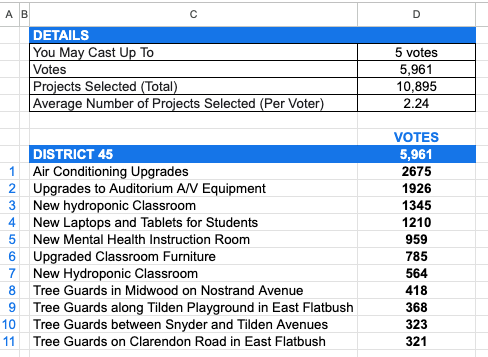
As I mentioned, the FOIL data that I got back had some problems. I’ll give you an example—look at the district 45 results from 2024 below. Two issues:
The number of voters (“Votes”) multiplied by the average number of votes cast (“Average Number of Projects Selected”) is 13,353, which is far different than the total number of votes cast, 10,895.3 Since I could confirm many of the voter totals from external sources, that led me to believe that the average was the problem. I’m still waiting on clarification from the council here.
The sum total number of votes cast across all projects is 10,894, which is one less than the listed total, 10,895. Many districts had this problem, with a variation around +100. I have no idea why this is, and am awaiting further clarification. It might be because of invalid or partially filled votes, but that isn’t reflected in the FOIL results.
Further: the results from 2023 and 2024 were formatted very differently, and contained different information. The 2023 results broke down the vote totals based on how they were cast, digitally or in-person.
If you have any questions, comments, or tips, send them my way! Drop them in the comments, or email me at daniel@maximumnewyork.com.
There are very small error bars around the vote totals. Like ±100 at the very most.
The 2023 council elections occurred on an “off year” due to getting redistricted after the 2020 census. This makes the 2023 election much more like the April 2024 participatory budget election, rather than the 2021 council election that lined up with a mayoral race.
You can cast multiple votes in participatory budgeting, and districts allocate these differently.
I find the assumptions of this analysis highly problematic and, consequently, its conclusion (PB is not "an actual democratic process") highly impoverished. First, has COVID-19 and its aftermath impacted civic engagement and public participation in general and PB in particular? The social fabric has only begun to recover and it is no surprise that participation in PB declined in the early 2020s. Second, and more relevantly, how many people would be deciding (exercising power) to determine how to spend the public money in question if a District didn't allocate funds through PB? A single City Councilor plus maybe a few of their staff? How is PB not vastly more democratic even with the numbers you cite? Finally, and most importantly, isn't the comparison of PB voting to turnout in elections like comparing handful of apples to a mountain of oranges? New York has an entire public infrastructure for City elections built over 200+ years. Hasn't NYC had near universal suffrage since the 1920s? How does the size PB process outreach budget compare to the mountains of direct and indirect money spent on administer elections and advertise and promote candidates, not to mention all the media coverage of elections from local and national news outlets? Your conclusions here make a very poor man’s argument. The problem is participatory budgeting, it is that far too long we have done all the democracy we should be doing to run a truly self-governing society (participatory, deliberative, and electoral) on the cheap.
These “elections” should be required to include as an option a refund to the district’s taxpayers.