

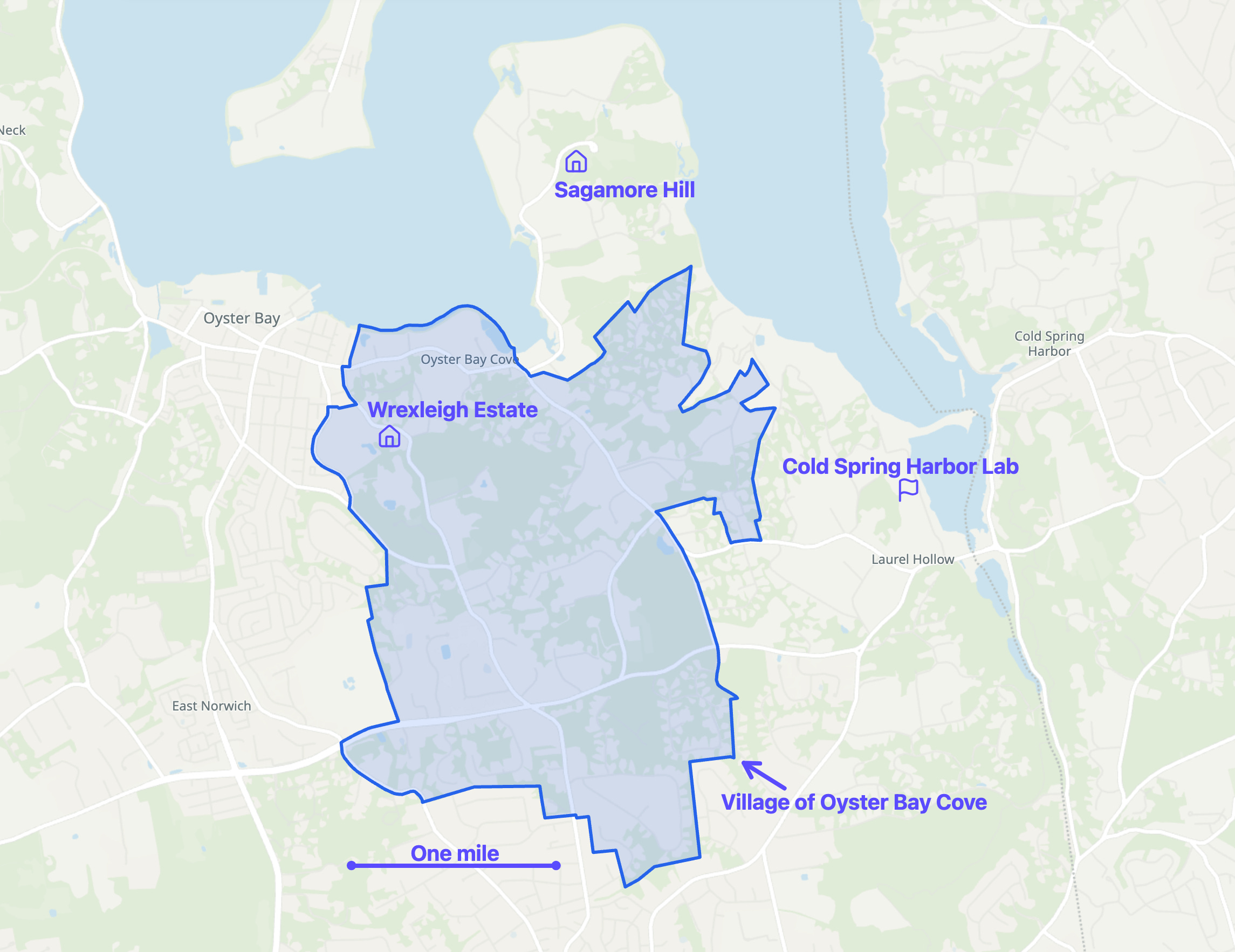
In 2024, Cold Spring Harbor Lab (CSHL) purchased the Wrexleigh Estate to convert it into housing for about 28 of its postdoctoral students. Previously, the site had been a residential “school for adolescent girls with mental and emotional health needs” which shut down in 2023. Despite the relative similarity in use, several local residents and groups opposed the CSHL purchase. They alleged that it would lower property values, negatively affect neighborhood character, and strain local infrastructure and the environment.1 Nonetheless, the lab eventually prevailed, and Wrexleigh is now being upgraded and prepared for the postdocs.
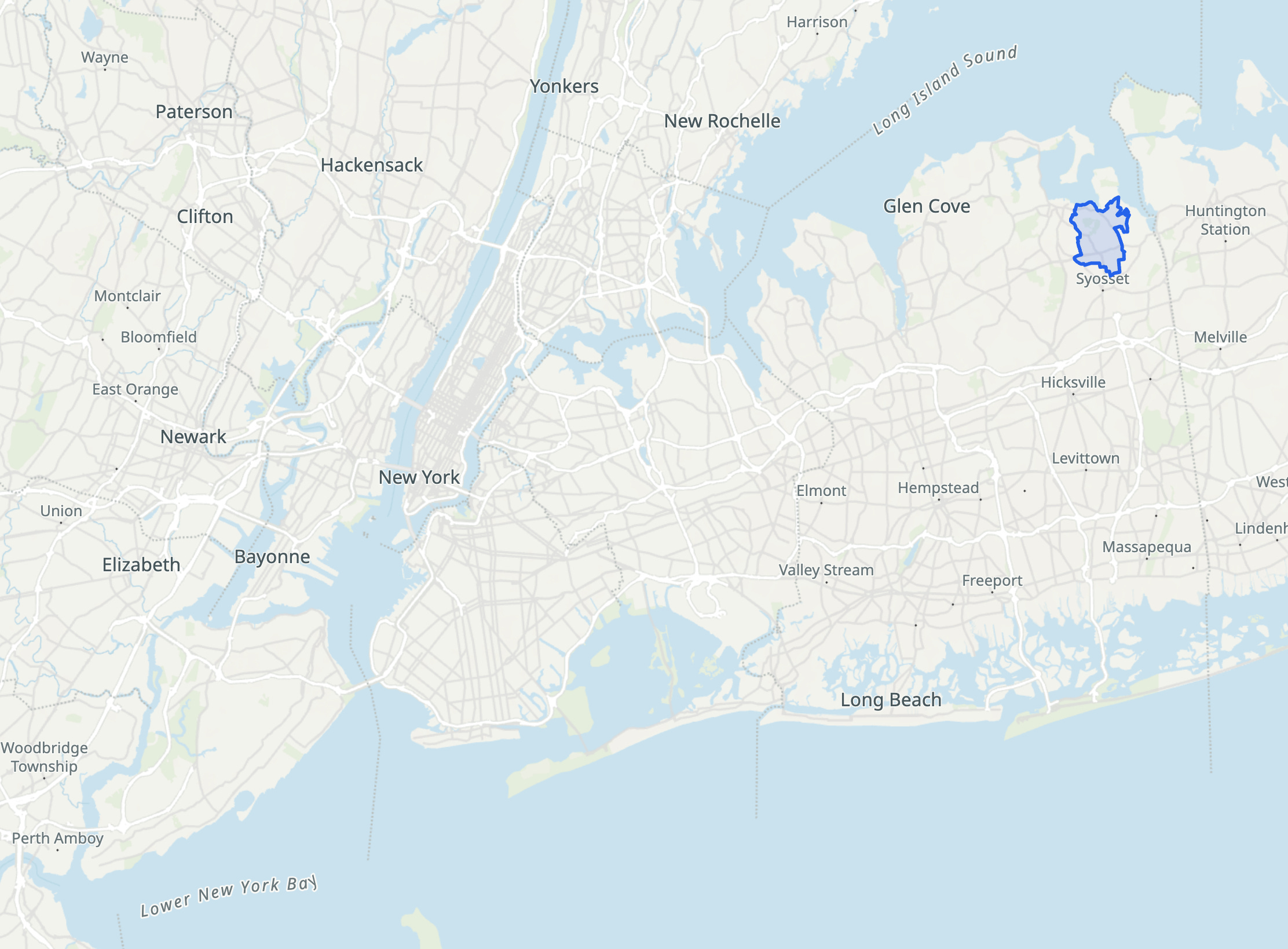
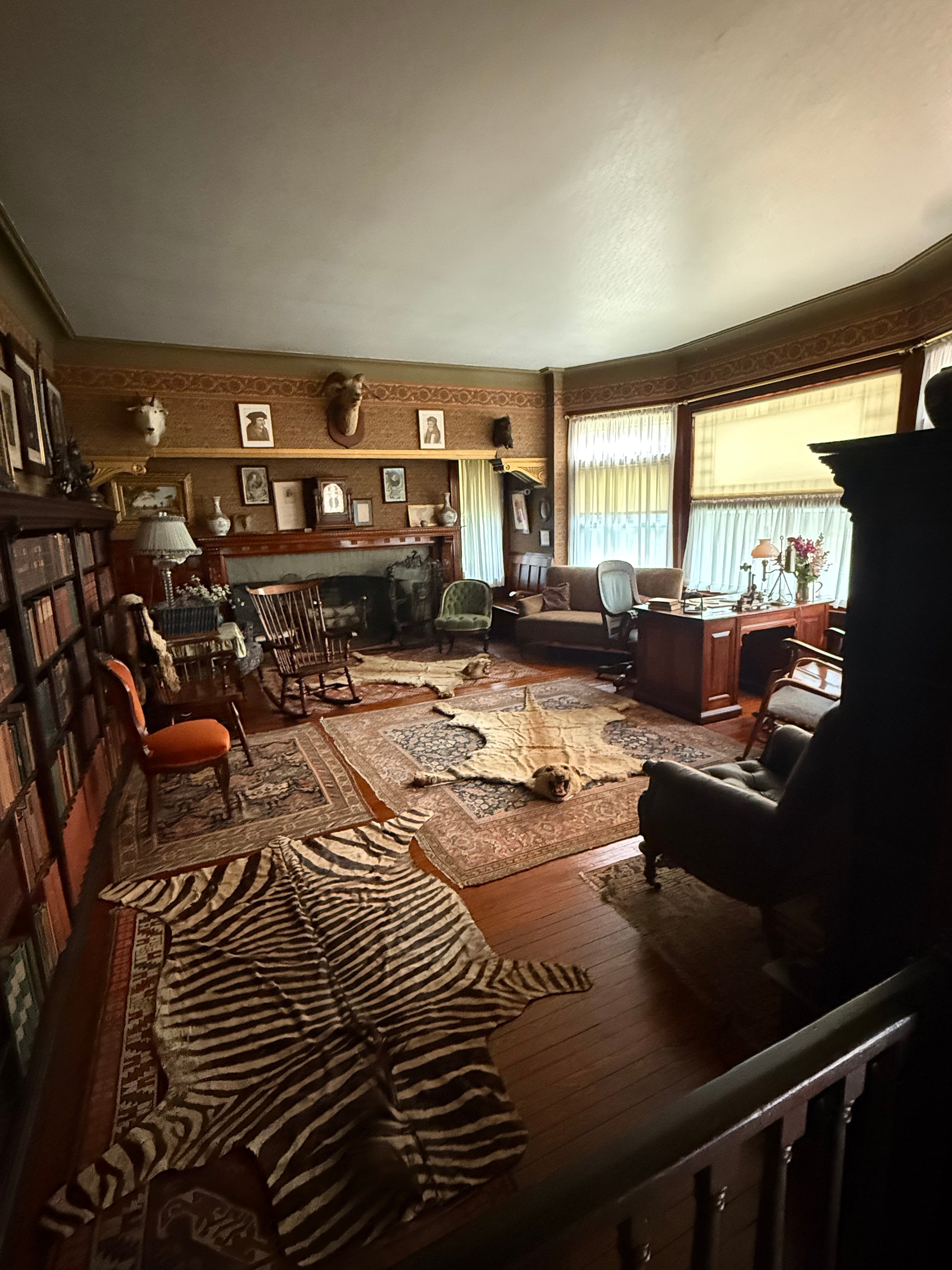
Both CSHL and Wrexleigh are located in the northeast corner of Nassau County on Long Island, in and near the Village of Oyster Bay Cove (OBC), respectively. I wanted to know more about the redevelopment story of Wrexleigh, so over the summer I spent a day going around OBC to see the site, talk to members of the community, and, crucially, meet the village’s mayor, Charlie Goulding. I also took several detours to visit a few of my favorite places in the area, like Theodore Roosevelt’s family home at Sagamore Hill.
A few weeks after my visit, after I’d had time to collect my thoughts and notes, I spoke with Mayor Goulding again via Zoom to get his views about the Wrexleigh redevelopment, the history and present of Long Island, the relationship between New York City and Nassau and Suffolk Counties, some views on governmental efficiency, and more. In addition to being the mayor, Goulding also owns and runs a specialty tax firm that advises industries across a wide variety of sectors. He is an attorney and a CPA.
My questions and comments are bolded, and Mayor Goulding’s responses follow in plain text.
1 · Introducing the mayor and the rezoning question
Thank you for making the time to talk again, Charlie. You’re the mayor of Oyster Bay Cove. Could you start by giving us some background on that—how long you’ve been mayor, what you did before, what do you do now as mayor, and how long you’d been in office before the CSHL rezoning project came before you?
I’ve been the mayor of Oyster Bay Cove for 10 years, and I was recently re-elected for four more years. And it’s important to note that Oyster Bay Cove is strictly a residential community — no commercial businesses. 750 houses and about 2,200 residents.
Regarding the rezoning, I don’t have exact dates in my mind, but a few years ago Cold Spring Harbor, which is a national laboratory, was kind enough to call me up and ask whether I would favor their purchasing a large estate in Oyster Bay Cove in order to have some housing for their scientists. And I said I thought it was a good idea. The estate they were talking about had already been used as a dormitory for young girls that had some challenging issues, and it had been used in that capacity for 28 young girls for 40 years. The nonprofit that was running it got to a point where I think it was too costly to operate. The buildings on the estate required millions in renovations and repairs. They attempted to sell it in the open market, but were unsuccessful.
So when they made the inquiry to me, I thought it was essentially the same use and a good idea. So I said to the laboratory, I have to ask my fellow trustees, because there’s five of us: the mayor, there’s a deputy mayor, and three other trustees. And all five agreed it was a great idea for the use of the facilities. Moreover, we knew that the laboratory had the resources to do it. And then I asked my planning board of five people what they thought. They unanimously thought it was a good idea. And then I asked my zoning board what they thought. They unanimously thought it was a good idea. So I had 15 of our, I’d say, most engaged citizens who thought it was a good idea.
We put it on our public agendas, held public hearings, sent out notices [throughout 2024]. We discussed it publicly, and I notified the entire village of what the intention was. I thought it was a fait accompli, and to me, at that point, it was out of sight, out of mind.
2 · Neighbor opposition and the “skyscraper” ad
But clearly it was not. How did a project go from proceeding so smoothly to suddenly hitting so much opposition?
Well once we’d gotten through most of the process, then all of a sudden we faced some very vocal opposition by maybe four or five of the neighbors. They formed an opposition group called Save Oyster Bay Cove, and they took out a television advertisement that showed a skyscraper, saying that this was what the village was embarking on. And we were all very taken aback, because that was a very inaccurate portrayal of the plan, which had no changes to the physical perimeter of the site or really to the buildings on it. It was going to stay exactly as it was. And these are postdocs—no families, no children, just very serious scientists.
3 · Newsday, community support, and the science case
And after that we were experiencing vehement opposition. But fortunately Newsday got involved, and they wrote an editorial, and they said that they thought it was a great idea. And then large numbers of members of the community got involved, and they felt it was a good idea.
Now, personally, I supported the project because of the science aspects of it. The Cold Spring Harbor Laboratory, probably known to many because of its longtime head Dr. Jim Watson (he discovered DNA with Crick), is a major lab for the nation and the world. They do tremendous research in a myriad of life science areas, including cancer.
4 · “DoorDash deliveries versus curing cancer”
So when I was interviewed by Newsday, what I said is: I’ve always found major decisions in life are a matter of balance. Nothing’s perfect. One of the objections to the project was, they alleged there were going to be too many DoorDash deliveries. One of the things that I found to be a little ridiculous about that is the scientists get meals provided at the laboratory. So they can get all their regular meals there. And, yes, they’re human beings, they might also order a pizza. But they thought that was ridiculous. And so my comment to Newsday was that if you have to go on a scale, it’s some DoorDash deliveries versus curing cancer.
I’m pleased to say that with the support of the community, the project was approved and enabled to go forward.
But I want to make it clear: residents have a right to object to a project, particularly one that’s in close proximity. That’s actually one of the standards under New York law, how a project impacts immediate residents. What I didn’t like was the distortion. Certainly the people had a right to express their disapproval and to oppose the project. But the distortion was just not helpful to reasoned debate, and actually thinking about the advantages and disadvantages of the project.
5 · Where the renovation stands
What is the status of the project now? Has any renovation begun?
I know the lab has been proceeding with the renovation. I know they’ve also worked with the neighbors to find out about their concerns when it comes to what you would call cover and screening, with shrubbery, landscaping and things like that. And as I understand it, any point brought up by a neighbor has been addressed and accomplished. I don’t think the lab had any issues with what the neighbors asked for — screening and things.
6 · YIMBY/NIMBY framing and “an identical use”
At the very beginning of our conversation, you mentioned something that is important context when you were talking about Oyster Bay Cove. You said it’s all residential. And then you mentioned a couple of other things I think are important to layer on: context for a project is important; people have a right to voice their approval, their disapproval; and that the use of the postdocs is not dramatically different than what had come before. Sometimes people use this very stripped-down YIMBY–NIMBY dichotomy that maybe is a little bit too simplistic for what you have just laid out. I was wondering if you could discuss how you thought about the project philosophically, in terms of land use, in terms of what makes sense to go in Oyster Bay Cove. Would you have used the words YIMBY or NIMBY, or is that not even the right way that you and other people were thinking about this?
Yeah, I often see the NIMBY word floating around. I was never thinking about it in that context. I thought it was neighbors perhaps not fully understanding the nature of the project. Because once there’s a portrayal of a skyscraper, when in reality there was no change to the perimeter, that really distorts everything. And I’m not so sure there was an understanding that it was strictly single postdocs, no children. And one would have to know the history and know exactly how it was used before to appreciate that it was not really a big change from that. And this was, in my mind, an identical use.
Now, I certainly may have my own biases. I would look at postdocs—life sciences and very serious people—and would never be concerned about their behavior and their use of the place. And the lab has a stellar reputation where it operates in Cold Spring Harbor. It has other facilities in Lloyd’s Neck and in Plainview, and in all cases its reputation is stellar. It’s a key part of the overall area. It also works quite closely with Stony Brook University. It works quite closely with Northwell. It’s part of the economics and structure of Long Island. It’s a draw for young talent.
7 · Young professionals and the cost of housing
And in your area of Long Island, Oyster Bay Cove and the surrounding northeast corner of Nassau County, how would you find young people now? Not just the postdocs, but early-career professionals? And I know that you personally employ a lot of these at your company. How would you say they are looking at Long Island, building a life there, getting a house there? From your view, what does that situation look like for them?
That’s an interesting point. I happen to employ lots of professional young people. The majority of the people on our team are degreed engineers. We have nuclear, chemical, mechanical, electrical, software, and biomedical engineers. They happen to be, I think, very pleased to have a job on Long Island where they can utilize their skills. I think seven of them went to Stony Brook as undergraduates too.
Now, there’s no getting around it: Long Island is an expensive place. They just disclosed average home price data in Nassau and Suffolk County. We’re talking $750,000, $850,000 for the average home. It’s certainly a difficult hurdle for anybody, never mind young people, to get a home. So housing has been a challenge for a long time. However, there are more initiatives for lower income taking place in the Mineola area or in the Hempstead area. It’s steadily coming.
On that latter point, those are government subsidized, rather than market rate. “Low income” housing is generally provided by a developer who gets a tax break to make that price point work, and the below-market rents don’t crash the building finances because there are usually market-rate apartments there too. One thing I wonder, just out of personal curiosity, and I’ve been asking around the civic sphere, is that you don’t really hear the phrase “workforce housing” these days, and maybe you did in the past. I would include the Cold Spring Harbor housing under this designation. And so I often wonder, do people think about just putting in “workforce housing,” as opposed to subsidized “affordable” units? Everyone needs housing, especially the people with jobs, and especially the middle class. Why not market new housing that way? Do you have any thoughts on why we don’t hear that word as much?
It’s an interesting observation. I haven’t really thought about it, I have to be honest with you. Sometimes it has a connotation where people start to think about company towns or farm migration situations. So I think that’s my only reaction when I hear that word. In fact, there are other organizations besides the laboratory that want to get high-caliber personnel. They have to address the housing issue in some fashion too. So there’s something to the idea anyway.
8 · Long Island’s industrial past
In your own company alone, it’s clear that there’s talent that’s being trained and produced on Long Island, and that, given the opportunity, it will stay on Long Island. And you’re providing some of that opportunity. I was wondering if you could talk a little bit about the past of Long Island: the industry that used to be there, the kinds of things that used to be there, maybe the kinds of things that could be there again. How do you view where Long Island has been industrially?
Well, I was born on Long Island in 1950, so I can observe what’s taken place over time. And when I grew up, the biggest employers were Grumman and Republic, for aircraft. A lot of people don’t realize the semiconductor industry, with Fairchild Electronics, actually started on Long Island, on Robbins Lane in Syosset. And of course it migrated to San Francisco and Silicon Valley. So Long Island has had a history of having some great industries that were centered here and then left the area, I think because of a combination of high costs. And back then, there wasn’t an integration of our universities with the major companies.
When you think about Silicon Valley, immediately you think about semiconductor companies. But you also think about Stanford University, and that the college was deeply integrated into industry. And many of the professors had one foot at the university but another foot at major high-tech companies. Long Island has that history too, and of course could do it again. I think when people spend time here, they see what’s possible.
9 · Long Island’s image
We have a new president of Stony Brook University and a new president at Hofstra. They’re both from out of state; recently I was at an event, and they both indicated they’re amazed at the positive morale and attributes of what we have in terms of the education system, in terms of our waterways. We are a 120-mile island. It’s great for boating, for swimming. We’re a golf course mecca. So it’s kind of an interesting thing—sometimes Long Island has a public image that changes when people get here and see what we have to offer up close.
10 · High costs vs. high-paying jobs
You mentioned that one of the reasons why a lot of industry left—and I think that’s a good point about not integrating with universities in the past—and you also mentioned high costs. And so maybe some of that is housing, and some of it is also the cost of running an industry on Long Island?
Well, you’re making me think out loud. I think we all know San Francisco as a high cost place. So, yes, they’ve confronted the same issues. But sometimes I think the cart’s before the horse here. I think we all see the value of lower-priced housing, so that people can get by. But on the flip side, I’d say that the priority should be better and high-paying jobs. Because if you no longer have a low income, then you don’t have to worry about low-income housing. You can afford your housing. Of course you have to build the housing too.
So I am watching the people that work in my firm when they have significant others. Generally in their case, because the majority of the people that work in our firm have graduate degrees, their significant others often are highly educated and have good jobs. And they can make their way and purchase a starter home and get started on Long Island. But you can’t do that unless you have a good job.
11 · What policy could do: life science and wet lab space
Right. And so when you think about — maybe development’s the right word, maybe it’s not — but when you think about the future of Long Island and industry, high-paying jobs, making a good living for yourself, what do you think would be a way that governmental policy could help these things establish themselves again, and even further, on Long Island?
I think you have to be realistic about your environment. Long Island is not going to be a large distribution center, for example. First of all, we’re on the extreme of the East Coast. Land and buildings are expensive here. So you’re not going to have a million-square-foot warehouse or 500,000-square-foot warehouse, as you see in New Jersey and Pennsylvania. Long Island has to look at its attributes and then act on those.
I think we’re a great area for life science innovation, and we have to attributes and potential to go even further in that direction. We have great clinical hospital organizations. They have brilliant physicians and medical professionals who work here. Well, in order to support them and their entrepreneurial efforts, we need, for example, more wet lab space. There’s a lot of very bright people who want to take an idea they have after seeing patient experiences and come up with a new medical device or a new drug. We have to be able to provide wet lab space that they can easily access and utilize.
Wet lab space requires sophisticated HVAC and other equipment hookups. It’s always been a challenge, even in New York City, because historically, even New York City didn’t have the access to wet lab space where a physician could walk out of a major hospital and go a few blocks down the street and engage in their experiments or their product development. More of that has occurred recently.
12 · The relationship between New York City and Long Island
And how do you think about the economic relationship between New York City and Long Island? What do you see when you look at the younger workforce? Are they going into the city and then coming back out? How would you characterize the relationship, from your view?
That’s an interesting question. We kind of learned this in our own firm. I spent the first 30 years of my career in New York City, and I actually love New York City, and love working in New York City. But you do wind up with young people with one of two orientations. Some people can’t wait to work in the city as soon as they graduate. Other people would prefer to stay closer to home on Long Island, particularly if they have strong family connections or they have a relationship with somebody on Long Island. So we now try to determine—it’s not easy—whether we think someone is really interested in working in the city or working on the island. Because it is costly to hire someone, train them, and then lose them to New York City. So I love being in close proximity to New York City. We have lots of clients in New York City. We benefit from New York City. But Long Island does have different attributes.
13 · How a business background relates to public office
I want to shift gears just a little bit. Earlier we mentioned that you have your own company, a specialty tax and accounting firm, and you’re also the mayor, and those things sit side by side in your life. How would you say your long private-sector experience has changed how you operate as a public servant, especially doing cost-benefit analyses?
It has certainly impacted how I operate as mayor. I do have a financial background. I’m an attorney and a CPA. And the first 30 years of my life, I worked for two Fortune 100 industrials, and being on the finance side, I was always looking at cost. However: when you get over to government, it’s a “nonprofit” organization, and there are certain mission imperatives that you have to somehow finance and complete. Certainly that would be policing: about 80% of our budget in Oyster Bay Cove is for police. So you have to have safety in your community.
Some of the things I’m directly involved in can be helpful to the community, because we have essentially two practices: one in the energy efficiency area and one in the innovation area. And energy efficiency is always relevant, to keep the costs of running the village at a minimum. And I have found a financial background is very helpful.
We also have to meet state mandates. They want us to try and limit the growth of property taxes to 2% total, which frankly is impossible, because the mandatory benefits provided to police and the other government workers often grows at the 10% level. So mathematically, you can’t take 80% of your budget that is increasing at 10% and then have that be funded by a 2% increase. I’ve always found that sort of pie in the sky, and kind of ridiculous, to have that 2% target. The math just doesn’t work.
So, yeah, I guess what I’m trying to say is I think financial discipline is very important in operating with this reality. But again, there are other missions you have to execute on. The roads have to be fixed, you have to have fire protection, and you have to have your policing.
14 · What idea would you incept into New York City policy people’s heads?
Sometimes I find, here in the five boroughs, that there are people who don’t get out on Long Island very much. Maybe this characterizes myself a little bit, although I visit about once or twice a month for one reason or another. But if you wanted people in the five boroughs—maybe younger people who are getting into government and policy, especially state policy—to understand some things about Oyster Bay Cove specifically, or maybe about Nassau County specifically, and you could incept a couple of things into their heads, what would you want them to understand about where you are?
What I’ve always liked about the local area is you have a complete range of economic situations. My wife and I started out in a modest apartment in Hicksville, Long Island, a very nice local community; Hicksville and Bethpage were the center for Grumman back in the heyday. And then what a lot of people in our area do is, they’re fortunate enough to be reasonably successful, they move to some of the nearby communities, which can be Syosset or Jericho, or somewhere like that. And if they’re even more successful, they can move up further to some of the North Shore communities, like Oyster Bay Cove. But also, when they get to a stage in life when they’re empty nesters, they can reverse course and go back.
So I’ve seen many people do the full cycle. Many of our residents in Oyster Bay started out either living in the city, or living in a different community on Long Island, or living on the South Shore. And then, if they’re fortunate enough to have economic success, then they move to communities like Oyster Bay Cove. So I like the fact that there’s that whole range that you could use over the spectrum of your life.
15 · Long Island’s school system, and its talent retention situation
Do you have a second thing? I think that’s a great one. It’s a beautiful to have that range in an area.
Well, it’s well recognized we have fantastic K–12 schools. I think that people will come to many communities in this area—it can be Great Neck, it can be Syosset, Jericho, Cold Spring Harbor, Smithtown in Suffolk County, Dix Hills. We have just great K–12 schools.
One of the challenges Long Island has is people get this wonderful K–12 education, and increasingly they go to college out of state. A lot of the Southern schools that were not popular when I was young have become popular, like Vanderbilt, Clemson, the University of Alabama, or the University of Tennessee. And when our students go to these communities, they see a nice lifestyle and a different economy, and many of them choose then to live in that area. I have a son with his family who’s relocated to Dallas for those very reasons.
So Long Island has a challenge. It’s a great job of educating K–12, but it has a tough job of retaining the fruits of that system.
And would part of that retention be different industries, different jobs? What would that retention look like? In an ideal world, where you could wave a magic wand, what would help with that retention?
In my mind—and you have to realize I have a connection to a lot of innovation, tech, and life science—I think we need more of the kinds of interactions like you see between organizations like Hofstra and Stony Brook with Northwell Health. Stony Brook now is becoming a national center for quantum mathematics. That’s going to, I think, give us the potential to produce some great things. We have Brookhaven Lab and energy-related projects. We have some great resources, and we have to make sure the young people realize that, and realize the opportunities on Long Island.
I think that’s a great place to end. Thank you for your time, and I hope everyone takes a tour around Long Island if they haven’t before.
For details about the opposition to the Wrexleigh redevelopment, see “Cold Spring Harbor Laboratory’s purchase of 57 Sandy Hill Road property leaves Oyster Bay Cove residents feeling betrayed” (January 31, 2025).