

In my previous post on the electrical grid, I mentioned that I would be offering a “Foundations of the Grid” class this fall. I am also working on a “How to be a Good Party Member” seminar, which you can register interest for here. The seminar will admit Democrats and Republicans; this is both to make it more interesting, and because it is vital to the class. My call to action: if you are a party official or similar who’d want to talk to the class, email (daniel@maximumnewyork.com) or DM me.
The nature of my work with Maximum New York keeps me in regular contact with people across the political spectrum, and at all three levels of government. Personally, I have friends and family across the spectrum too. I love them all! And I am also convinced that we need people to be better party members, whatever their party.
So here are some quick thoughts I find myself repeating when I discuss political parties. They all influence each other, and do not exist in isolation.
Table of contents:
1) Party affiliation is unilateral opt-in
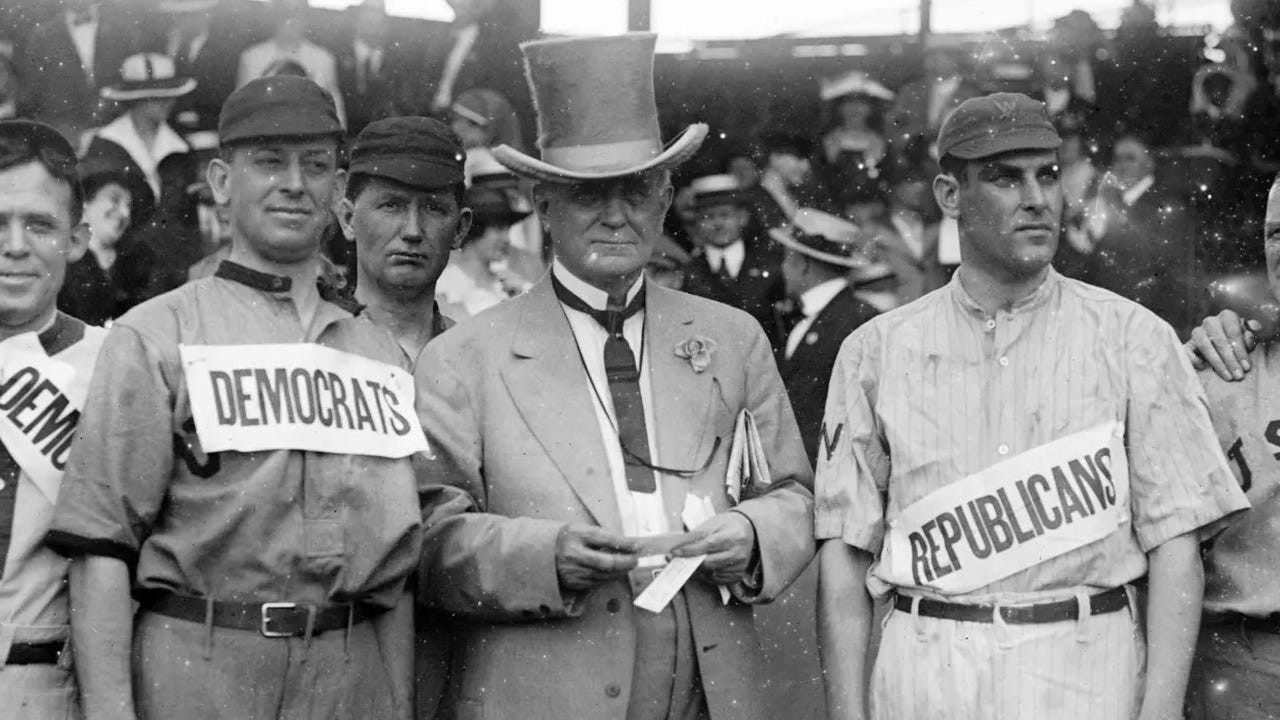
Anyone can affiliate/register as a member of any political party in the United States.1 Right away, this tells you that superficial party identification can hide substantial variation in policy views and motivation below the surface. Party affiliation is not the result of a vetting process on the front end,2 rather a unilateral opt-in.
2) Parties are not a monolith
People often speak about “Republicans” and “Democrats,” and use those broad labels to describe politicians and people in every context without differentiation. But parties are not monoliths. If you want to have a good working model of them, you need higher resolution. [Aside: New York has four official political parties, and there are also independents. For this post, I am primarily discussing Republicans and Democrats, although much of it applies to the others as well.]
The most important example: there are national party entities, and state party entities. While they are affiliated, they are distinct; further, the structure of the affiliation is not the same in every party. And we all know that “Democrat” refers to different ideas and kinds of elected officials, on average, in California versus Georgia.
Keeping the state/federal party distinction clear in your head is important for evaluating sentences like “X Party is terrible on Y issue area.” Well, it’s quite possible for the national majority of a party to be bad on an issue, but for its affiliated state majorities to be the best in the whole country. You need to map that out for a clear-eyed picture of reality (or make sure your intellectual proxies do).
3) Parties are an ecosystem
While political parties are not a monolith, they are also not isolated collections of discrete things. They are ecosystems that span different layers of government, institutions, formal and informal relationships, and more. Coincidentally, Ezra Klein recently interviewed the former head of the Democratic Party of Wisconsin, Ben Wikler, and they addressed this directly:
Ezra Klein: What is the Democratic Party? Actually, mechanically, what is it? What are its powers? Who comprises it? When you call the Democratic Party, who picks up the phone? And what could the Democratic Party be if it were reinvented for this era?
[…]
When people think about the Democratic Party, when they hear those words, when a pollster calls them and says: What do you think of the Democratic Party? — what do you think those words activate in their mind?
What do people think the Democratic Party is? And then as somebody who ran one branch, what is the Democratic Party?
Ben Wikler: It means whichever thing is most salient to people.
The first, and the most common, is the amorphous blob of every elected official, every pundit, every annoying person they see online, all the things that are associated with this vast, interconnected web of all things Democrat related.
That is not one thing. There’s no person who controls that. In a sense, if you have a Democratic president, that person is the head of the amorphous blob. Donald Trump is very much the head of the blob on the Republican side.
There’s also the formal Democratic Party, which is the literal institutions. I was chair of the Wisconsin Democratic Party. There’s the D.N.C., the Democratic National Committee. There’s the Democratic county party system, so we have a Democratic Party of Iowa County, Wis. There’s also a Democratic Party of Iowa County, Iowa.
If you want to get more of an idea of these political party ecosystems, and how the Republican and Democratic ecosystems are different, I would recommend:
The American Political Party System: A Reference Handbook (2017). Not only does it get into the nuts and bolts of legal party organization, but it presents a good summary history of the partisan system in America. However, note that it was published almost a decade ago. While most of the book remains fresh, some things have changed (ask AI to summarize links to anything that’s changed since this book). An example of an important ecosystemic change: National Republican Senatorial Committee v. Federal Election Commission (2026).
Patronage vs. Constituent Parties (Or Why Republican Party Leaders Matter More Than Democratic Ones) (2024) from T. Greer. You might or might not agree with his conclusions, but this piece is an excellent example of structural comparison between the Republican and Democratic parties.
4) Party affiliation is different from practical party membership
When most people say “I am a Democrat” or “I am a Republican,” they’re usually referring to which party they typically vote for in presidential elections foremost, and then who they vote for in other races.
I would call this “party affiliation” if we’re being strict. It’s not party “membership,” because…what are you a member of if you just vote a certain party ballot line? You pay no dues, attend no meetings, and so forth.
And while party membership isn’t like membership in a private association in the United States (remember, they can’t stop you from joining), I would say party membership practically means regularly engaging in efforts to sustain, expand, and advocate for your party and its ideas. It also means participating in the party as an elected/designated official of that party. In New York State primaries, voters might notice (although most of them do not understand) offices like “district leader.” These are not like the public offices of mayor; they are internal party positions. Take a look at this section of New York State election law, ELN § 7-116(5):
The titles of public offices shall appear on ballots for primary elections in the same consecutive order that they will appear on the general election ballot. The titles of the party positions shall appear in the following order: member of state committee, assembly district leader, associate assembly district leader, members of county committee in the city of New York, delegate or delegates to conventions, alternate delegate or delegates to conventions, and members of county committee in counties outside of the city of New York.
5) Parties are big tents, no way around it
Because party affiliation is unvetted, and because the parties are vast ecosystems, it is guaranteed that any party affiliate will be sharing their affiliation with individuals they personally abhor, and/or who possess views they don’t want to defend.
This is a tricky thing indeed.
For many people, this means fearing guilt by association, and it means being accused of shielding, tolerating, and perhaps sharing those odious views. No party affiliate (none of us) is safe from this. In the first instance, party affiliates might suffer at the intolerant hands of their own friends, family, and acquaintances. Actual party members and people who have any public presence will get accusations thrown at them from more sides.
However, it is also an opportunity to boldly adhere to your own values, and live up to the difficult, honorable, sometimes satisfying, sometimes fun task of holding together a party coalition to advance ideas and policies you think are correct. This also means recognizing that your allies in another party are going through the exact same thing, and that, as a matter of truth seeking, you should not conflate all members of a party with their worst or most visible affiliates. This will obscure inter-party allies at best.
The nature of any party’s big tent changes over time, but any party affiliate will always have the associational pressure discussed above.3
See this X exchange I had with Zac Hill, who put it well:


Also: the “big tent” nature of parties doesn’t just manifest as difference in view. It can also manifest as differences in personality, forcefulness, combativeness, and willingness to “slug it out” in certain domains. Every party needs people across the spectrum here; some people are more wonky and behind the scenes, some are more public and combative. Whatever coalition you’re in, you’ll have combative types, likely ones you both agree and disagree with.
6) Party affiliation has wonky and cultural associations
Sometimes people only want to be associated with the more technocratic, less culturally controversial elements of their party.
But I agree with Sam as seen in the post below. The parties each have broad cultural associations that wax and wane in different parts of the country.
Our task is not to bemoan this, but to chart the best course through it. It has ever been thus!

7) How do people pick which party to be in?
As I write this, I’m thinking of one friend whose politics are almost identical to my own, and yet we are in different parties. I think this is more common than many people suspect. It also points to an important lesson about political parties: affiliation can be extremely high dimensional.
Here are some things that influence party affiliation in an overlapping fashion:
Social cohesion. Which party are your friends in?
Policy alignment. Which party shares most of your ideas?
Policy emphasis. Perhaps both parties have the same position, but one emphasizes it differently in a way you like.
Local, state, or national bias. Parties manifest differently at different levels of government. Which level of government do you emphasize most heavily, and which will primarily dictate your party preferences? (Personally, mine are city and state.)
Temperament. Which party has members with a temperament more akin to your own?
Philosophical alignment. Which party matches your view of government and America?
Milieu. Which party has the vibes you want?
Tactics. Which party can help you achieve your vision of the good for your city, state, and country?
Inertia. Your parents were Democrats, your grandparents were Democrats, and by God you’re a Democrat! (Repeat for Republicans.)
8) We need good people in each party
I have a partisan, party identity. But my superseding political identities are New Yorker (city and state) and American. I believe it is good to join a party, make the case for your vision for it, and drive it toward achievement on behalf of your locality, state, and nation.
I am not inherently suspicious about someone being a Republican or a Democrat. They’re both viable options, depending on context. I’m more interested in why you are in a party, and what you do over there. I do this at the same time as I hold my own party affiliation. These things are always in at least a little bit of tension.
I also believe it is not just good, not just necessary, but often enjoyable to work with people in different parties who are similar to me. Together, we operate on the same “meta team” for America and New York, while still holding to the differences in view that result in different party affiliations. (See the phenomenon of Secret Congress.)
No party has a monopoly on good ideas, and we need multiple parties to apply competitive electoral and policy pressure so that none of them gets complacent.4 New York, at the moment, has an insufficiently competitive minority party (Republicans). This has not been healthy for our state Democrats, who have to get their primary Republican competition from red states.
Finally: sometimes when I discuss pulling together an intra-party tent, or working with other parties for the overall good of our city, state, and nation, people think I’m describing some cotton candy, cartoon world. I am not. This kind of operation is high skill, high value, and the kind of thing we need from more people. It can feel turbulent in the moment. But it is a very American thing to do.
Here’s how I described it when discussing the friendship between Supreme Court justices Scalia and Ginsburg:
One can read a story like this and get a feeling of warm fuzzies—indeed, it is often written about that way. That is not what I’m doing here. If you zoom in on the concrete reality of Ginsburg and Scalia, you would see vicious attack and counterattack in their opinions. They sharply disagreed, and they did not moderate or back down from their convictions; but it was exactly their mutual adherence to this personal integrity, married to the common goal of the American constitutional order, that produced the best work from both of them. I don’t think they would have respected each other if either had put away their blade for a second.
The ability to do this civilizationally load-bearing work—while disagreeing, while remaining close friends—is a mark of competence, self-control, and “eye on the prize” mentality. They both kept the terminal goal of American constitutionality front and center, and worked together from their different operational perspectives to jointly buttress it.
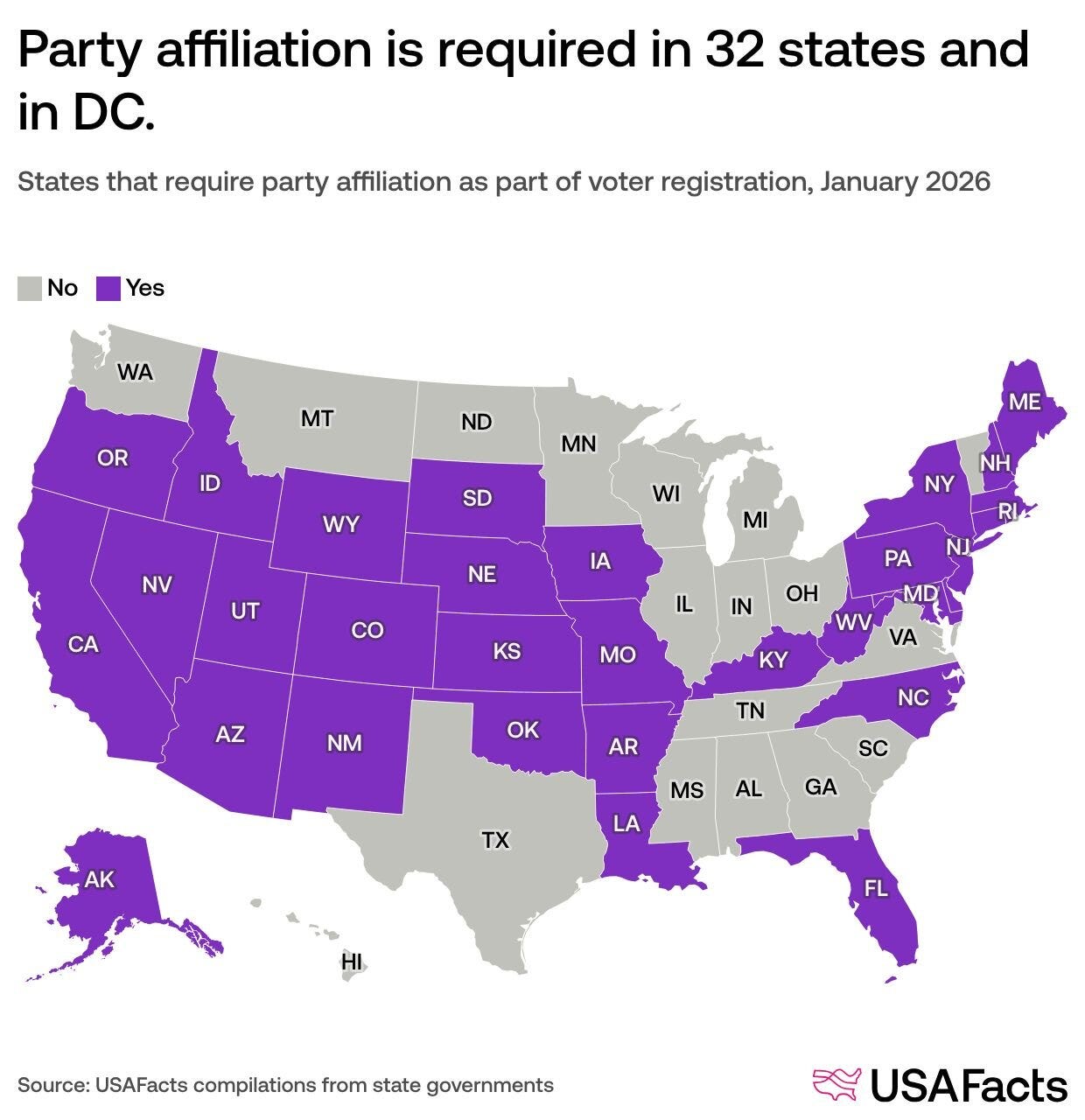
There is a substantial amount of nuance here, but none of it impairs the main point. For example: most states, like New York, collect your party affiliation as part of the voter registration process; you can check whatever box you want. Other states don’t do this, or do something different. However, for purposes of voting in presidential primaries, all states possess a mechanism that practically sorts people into parties.
This has been litigated. For example: the 1944 SCOTUS case Smith v. Allwright: the Texas Democratic Party limited voting in its primaries to white people. The Supreme Court disagreed. In the modern era there are, technically, methods to “review” party affiliation, but they are defunct in practice, and they are not poised to come roaring back for a variety of practical reasons. For example, Indiana technically has a “majority test” on the books; see IC 3-10-1-6:
Sec. 6. A voter may vote at a primary election:
(1) if the voter, at the last general election, voted for a majority of the regular nominees of the political party holding the primary election; or
(2) if the voter did not vote at the last general election, but intends to vote at the next general election for a majority of the regular nominees of the political party holding the primary election; as long as the voter was registered as a voter at the last general election or has registered since then.
You can see how this is practically unenforceable. Paragraph (1) is impossible to check, because the state can’t force someone to divulge how they voted. Paragraph (2) is impossible to verify for obvious reasons.
The toughest example of this pressure is the instance when you actually can’t bring yourself to vote for your own party’s candidate, or even vote for the other party’s candidate!
This can result in a competitive race to the bottom, but it can also result in one party remaining in power because voters genuinely like it more. We see both throughout the variegated American system.
Appreciate the shoutout — and, in particular, the need for +EV parties and members of each party. The goal is *a* better America, *to* better America. The rest is a fight, and a battle, but not a war.
You may be interested in this open-access paper: https://doi.org/10.1093/poq/nfaf065. It’s part of a larger research agenda on the party system.